

Telecom Expense Management Market Size, Share, Growth, and Industry Analysis, By Type (Dispute Management, Inventory Management, Invoice and Contract Management, Ordering and Provisioning Management, Reporting and Business Management, Sourcing Management, Usage Management, Others), By Application (Automotive, BFSI, Consumer goods and retail, Healthcare, Manufacturing, Media and entertainment, Transportation and logistics, Others), Regional Insights and Forecast to 2035
 Buy Now


Telecom Expense Management Market Overview
The global Telecom Expense Management Market is projected to expand steadily from USD 5234.31 Million in 2026 to USD 11947.27 Million by 2035, representing a CAGR of 9.6% during 2026-2035.
The Telecom Expense Management Market is expanding as enterprises manage increasingly complex combinations of mobile connectivity, fixed telecommunications, cloud communications, unified collaboration platforms, connected devices, and distributed workforce services. Approximately 64% of large organizations are prioritizing centralized visibility across telecom invoices, contracts, inventories, usage records, service orders, and vendor commitments to reduce unnecessary spending and improve financial governance. Modern telecom expense management platforms are evolving beyond basic invoice auditing toward automated anomaly detection, contract optimization, inventory reconciliation, cost allocation, mobility administration, and data-driven sourcing.
The United States represents one of the most developed national markets for telecom expense management because of its large enterprise base, complex carrier ecosystem, extensive corporate mobility usage, multi-location operations, and widespread adoption of cloud communication services. Approximately 41% of U.S. enterprise users place strong emphasis on automated invoice validation, contract compliance, mobile expense control, service inventory accuracy, and technology-spend transparency. Organizations are increasingly integrating telecom expense management with procurement, IT service management, enterprise resource planning, mobility administration, and financial operations.
Get Comprehensive Insights into the Market’s Size and Growth Trends
 Download FREE Sample
 Key Findings
- Market Driver: Enterprise demand for centralized technology-cost visibility is accelerating adoption, with approximately 66% of organizations prioritizing automated control over telecom invoices, inventories, contracts, usage records, service orders, and recurring communication expenses.
- Major Market Restraint: Integration complexity remains a major implementation barrier, as nearly 35% of enterprises report difficulties consolidating fragmented carrier data, legacy billing formats, decentralized procurement records, mobility information, and contract documentation.
- Emerging Trends: Artificial intelligence and automated anomaly detection are reshaping telecom cost control, with approximately 48% of platform enhancement initiatives emphasizing predictive analytics, invoice validation, usage optimization, workflow automation, and intelligent exception management.
- Regional Leadership: North America is expected to maintain market leadership with approximately 36% market share, supported by mature enterprise procurement, extensive corporate mobility, cloud communication adoption, and widespread demand for advanced expense-governance platforms.
- Competitive Landscape: Vendors are broadening platforms beyond traditional telecom auditing, with nearly 32% of competitive initiatives emphasizing integrated technology expense management, managed services, artificial intelligence capabilities, mobility optimization, and cross-domain cost visibility.
- Market Segmentation: Invoice and Contract Management leads product demand with approximately 24% market share, while BFSI remains the dominant application among the eight supplied vertical categories because of complex communications infrastructure and compliance-intensive operations.
- Recent Development: Telecom expense platforms are expanding automation and managed-service capabilities, with around 29% of recent platform initiatives focusing on faster billing reconciliation, contract intelligence, inventory accuracy, cost allocation, and service optimization.
Latest Trends
Artificial intelligence is becoming a central development trend within the Telecom Expense Management Market as enterprises seek faster detection of invoice errors, contract mismatches, abnormal consumption, inactive services, and unnecessary recurring charges. Approximately 53% of digitally mature organizations are increasing interest in automated analytics that can evaluate telecom spending continuously rather than relying solely on periodic manual audits. AI-supported platforms can classify invoices, identify unusual billing patterns, compare charges with contracted terms, recommend service optimization, and prioritize exceptions requiring human review. This capability is particularly valuable for enterprises managing hundreds of carrier invoices and thousands of service records.
Another major trend is the convergence of telecom expense management with broader technology expense governance covering mobility, cloud communications, software subscriptions, connected devices, and distributed digital services. Nearly 46% of enterprises are seeking consolidated platforms capable of linking telecom financial data with procurement, IT inventories, service management, and employee usage information. Remote and hybrid work have made communication estates more decentralized, increasing the need for accurate ownership and allocation of mobile lines, collaboration services, and connectivity expenses. Cloud-based deployment is further improving accessibility by enabling global teams to manage spending through standardized dashboards and centralized workflows.
Market Dynamics
Driver
"Rising telecom complexity is increasing demand for centralized expense control."
Enterprise communication environments are becoming more difficult to manage as organizations operate across multiple carriers, countries, offices, cloud platforms, mobile devices, and digital communication services. Approximately 62% of large enterprises identify fragmented telecommunications information as a major obstacle to effective technology-cost governance. Telecom expense management platforms address this complexity by consolidating invoice, contract, inventory, ordering, usage, and vendor information into centralized environments. Automated reconciliation can identify services that remain active after employees leave, incorrect carrier charges, duplicated circuits, contract deviations, or unused subscriptions. These capabilities reduce dependence on spreadsheets and isolated departmental processes while improving coordination among finance, procurement, information technology, mobility, and operations teams.
Restraint
"Complex integrations and inconsistent carrier data slow enterprise implementation."
A significant restraint affecting the Telecom Expense Management Market is the difficulty of consolidating information from multiple telecommunications providers and internal enterprise systems. Approximately 38% of implementation projects encounter data-normalization challenges because invoices, usage records, service inventories, contract files, and provisioning information often arrive in different structures. Enterprises operating internationally may manage numerous carriers and billing conventions, increasing the effort required to create a reliable central dataset. Integration with procurement platforms, enterprise resource planning, human resources systems, and IT service management tools can further increase implementation complexity. Poor source data can limit automation accuracy and reduce confidence in analytical recommendations.
Opportunity
"Unified technology expense governance is creating new enterprise expansion opportunities."
The convergence of telecom, mobility, cloud communications, and recurring digital services creates a substantial opportunity for Telecom Expense Management Market providers. Approximately 49% of enterprises are seeking platforms capable of consolidating several categories of communications spending within one governance environment. This creates opportunities for vendors to expand beyond traditional invoice auditing toward integrated inventory, procurement, contract, usage, provisioning, and analytics capabilities.International organizations also represent an attractive growth opportunity because fragmented carrier relationships make cost visibility difficult across countries and business units.
Challenge
"Maintaining accurate inventories across dynamic telecom environments remains difficult."
Inventory accuracy remains a major operational challenge as employees, devices, locations, contracts, and communication services change continuously. Approximately 41% of organizations experience mismatches between carrier billing records and internal service inventories. Such discrepancies can lead to continued payment for disconnected lines, inactive devices, duplicate services, or incorrectly assigned accounts, reducing the effectiveness of automated expense optimization and financial reporting.Vendors must therefore provide strong integrations, automated reconciliation, configurable workflows, and continuous data validation to ensure that cost-control recommendations reflect current operational conditions rather than outdated records.
Telecom Expense Management Market Segmentation
By Types
Dispute Management: Dispute Management accounts for approximately 7% of market demand and helps enterprises identify, document, track, and resolve incorrect carrier charges. Automated case workflows improve accountability while helping organizations recover disputed amounts more efficiently.Nearly 31% of organizations using structured dispute workflows prioritize automated evidence collection and status tracking. Integration with invoice auditing enables enterprises to identify billing exceptions quickly and route them to appropriate internal teams or telecommunications providers.
Inventory Management: Inventory Management represents approximately 16% of market demand, reflecting the importance of maintaining accurate records for mobile lines, circuits, devices, numbers, locations, services, and assigned users across complex enterprise environments.Approximately 47% of large organizations consider telecom inventory accuracy essential for eliminating inactive services and controlling recurring expenses. Automated synchronization with carrier and internal records improves visibility while reducing dependence on manually maintained spreadsheets.
Invoice and Contract Management: Invoice and Contract Management leads the market with approximately 24% share because enterprises require continuous validation of carrier charges, contracted rates, discounts, service terms, renewal dates, and payment obligations.Nearly 58% of enterprises using telecom expense platforms prioritize automated invoice validation against contract terms. This capability helps identify incorrect rates, missing discounts, duplicate charges, unauthorized services, and contract deviations before invoices move through final payment processes.
Ordering and Provisioning Management: Ordering and Provisioning Management accounts for approximately 11% of market demand and supports structured requests for new telecom services, modifications, relocations, upgrades, and disconnections across distributed enterprise environments.Approximately 39% of organizations adopting automated provisioning workflows seek faster service activation and improved approval controls. Standardized processes also reduce unauthorized purchasing while ensuring that new services are entered into inventory and cost-allocation systems correctly.
Reporting and Business Management: Reporting and Business Management represents approximately 13% of the market as enterprises require centralized dashboards covering spending trends, vendor performance, departmental allocation, savings opportunities, and telecom utilization.Nearly 45% of enterprise users prioritize configurable reporting that allows finance, procurement, and IT teams to analyze communication costs from different perspectives. Greater reporting transparency supports budgeting, forecasting, chargeback, executive oversight, and sourcing decisions.
Sourcing Management: Sourcing Management accounts for approximately 9% of market demand and helps organizations evaluate telecommunications suppliers, negotiate contracts, compare service offerings, and select pricing structures aligned with expected usage requirements.Approximately 34% of enterprises using sourcing capabilities focus on improving negotiation leverage through consolidated spending information. Detailed historical usage and invoice data enable procurement teams to compare suppliers more effectively and establish stronger commercial terms.
Usage Management: Usage Management holds approximately 14% of market demand as organizations seek visibility into mobile consumption, connectivity utilization, international usage, employee activity, and service adoption across expanding communications environments.Nearly 43% of organizations applying usage analytics focus on identifying underused services and unusually high consumption. Continuous monitoring supports plan optimization, policy enforcement, capacity planning, and better alignment between purchased telecom resources and actual business requirements.
Others: Other telecom expense management capabilities represent approximately 6% of market demand and include specialized functions supporting workflow administration, mobility-related governance, custom integrations, service analytics, and enterprise-specific telecommunications processes.Around 28% of demand within this segment comes from organizations requiring customized workflows that standard platforms cannot fully address. Flexible configuration and integration capabilities therefore remain important differentiators when enterprises operate unusual service structures or industry-specific communication environments.
By Applications
Automotive: Automotive applications account for approximately 8% of market demand as manufacturers manage communications across plants, engineering centers, dealerships, mobile workforces, logistics operations, and connected production environments.Nearly 35% of automotive enterprises using telecom expense management prioritize visibility across multiple facilities and employee device fleets. Centralized controls support service inventory accuracy, contract optimization, and allocation of communications expenses across distributed operational units.
BFSI: BFSI leads application demand with approximately 21% market share, supported by extensive branch networks, compliance-sensitive communications, large employee populations, mobile services, contact centers, and complex enterprise connectivity requirements.Approximately 52% of BFSI organizations adopting advanced expense management emphasize detailed audit trails and cost accountability. Automated invoice validation, contract governance, and reporting help financial institutions manage communications spending while maintaining stronger operational controls.
Consumer goods and retail: Consumer goods and retail represent approximately 15% of market demand because enterprises operate distributed stores, warehouses, corporate offices, digital commerce platforms, and mobile workforces requiring numerous communications services.Nearly 44% of retail organizations using telecom expense management focus on controlling costs across large location portfolios. Centralized service inventories help identify redundant connections, inactive lines, inconsistent carrier pricing, and opportunities for contract consolidation.
Healthcare: Healthcare accounts for approximately 13% of market demand as hospitals, clinic networks, administrative centers, mobile personnel, and digital care environments depend on reliable telecommunications and connectivity infrastructure.Approximately 40% of healthcare organizations implementing telecom expense controls prioritize accurate allocation of communication services across departments and facilities. Automated reporting also supports budget management and improved visibility into recurring connectivity and mobile-service expenses.
Manufacturing: Manufacturing represents approximately 17% of market demand, reflecting extensive communications requirements across factories, warehouses, engineering offices, supply networks, field teams, and geographically distributed production operations.Nearly 46% of manufacturing enterprises adopting telecom expense platforms emphasize inventory reconciliation across multiple sites. Centralized visibility helps identify redundant services, improve carrier negotiations, and ensure communication resources remain aligned with operational requirements.
Media and entertainment: Media and entertainment account for approximately 9% of market demand as organizations manage high-capacity connectivity, mobile services, distributed production teams, offices, studios, and temporary project locations.Approximately 33% of users in this sector prioritize usage visibility because communication demand can fluctuate significantly between productions and events. Detailed analytics help organizations identify underused services and manage temporary connectivity more efficiently.
Transportation and logistics: Transportation and logistics represent approximately 11% of market demand, supported by fleet communications, mobile workforces, distribution facilities, warehouses, terminals, and continuously connected operational networks.Nearly 42% of logistics enterprises adopting telecom expense management prioritize mobile and location-based service visibility. Automated inventory and usage analysis can improve allocation accuracy while supporting cost control across geographically dispersed operations.
Others: Other applications hold approximately 6% of market demand and include enterprises requiring centralized expense management for fragmented communication services, employee devices, carrier contracts, and distributed operational environments.Approximately 29% of organizations within these specialized applications emphasize configurable reporting and integration capabilities. Flexible platforms enable enterprises to adapt telecom expense management to unique organizational structures, procurement policies, and communication requirements.
Regional Outlook
Get Comprehensive Insights into the Market’s Size and Growth Trends
Download FREE Sample
Get Comprehensive Insights into the Market’s Size and Growth Trends
Download FREE Sample North America
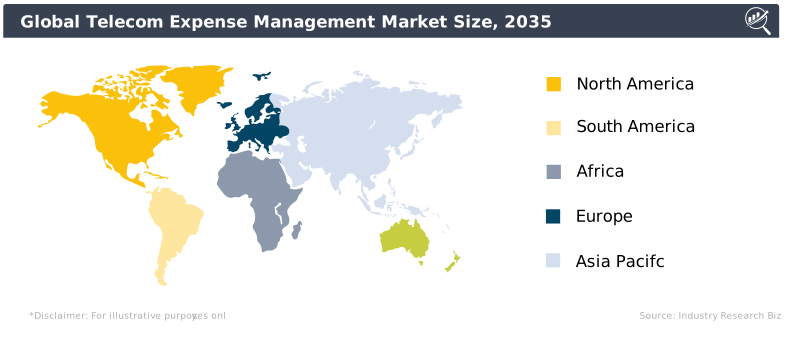
North America leads the Telecom Expense Management Market with approximately 36% market share, supported by high enterprise mobility penetration, complex carrier ecosystems, extensive cloud communication adoption, and strong demand for technology-cost governance. Large organizations across the United States and Canada frequently manage thousands of mobile connections, circuits, collaboration subscriptions, and distributed service contracts. Telecom expense management platforms are therefore widely used to centralize invoices, contracts, inventories, usage information, procurement records, and cost allocation. Increasing emphasis on automated auditing and financial accountability is also encouraging enterprises to replace fragmented spreadsheet-based processes with integrated platforms.The region also benefits from advanced integration between telecom expense platforms and enterprise resource planning, IT service management, procurement, human resources, and mobility-management systems.
Europe
Europe accounts for approximately 27% of the Telecom Expense Management Market, supported by multinational enterprises, mature telecommunications infrastructure, distributed workforces, and increasing emphasis on cost transparency. Organizations operating across multiple European countries frequently manage different carriers, currencies, contracts, billing formats, and regulatory environments, increasing the value of centralized telecom governance. Enterprises are adopting platforms that consolidate invoice processing, contract information, service inventories, usage records, and procurement data while enabling standardized reporting across regional operations. Demand is particularly strong among BFSI, manufacturing, consumer goods and retail, healthcare, and transportation organizations with operations spanning multiple countries. Cloud-based deployments are helping enterprises centralize data while allowing regional teams to maintain operational access.
Asia-Pacific
Asia-Pacific represents approximately 25% of global market demand and is expanding as enterprises increase investment in cloud communications, enterprise mobility, digital workplace infrastructure, and multi-site connectivity. China, India, Japan, South Korea, Australia, and Southeast Asian economies are contributing to adoption as large organizations seek greater visibility into rapidly expanding telecom environments. The region's growing multinational business base and widespread mobile workforce are creating demand for centralized platforms that can control carrier costs, service inventories, contracts, ordering, and usage.Continued adoption of cloud-based solutions is also lowering implementation barriers for organizations seeking centralized capabilities without large on-premise infrastructure requirements.
Middle East and Africa
Middle East and Africa accounts for approximately 7% of the Telecom Expense Management Market, supported by enterprise digitalization, expanding mobile workforces, large infrastructure projects, and increasing adoption of cloud-based business systems. Demand is concentrated among telecommunications-intensive organizations operating across banking, transportation, manufacturing, healthcare, energy-related industries, and public-sector environments. Enterprises with distributed facilities are beginning to place stronger emphasis on tracking mobile subscriptions, connectivity services, vendor contracts, and recurring communication expenditure.Enterprises are also using automated reporting and usage analytics to identify inactive connections, duplicated services, and contract inefficiencies. Growing digital transformation programs are expected to expand the addressable market as organizations become more focused on measurable technology-cost governance.
Rest of the World
Rest of the World represents approximately 5% of global market demand, encompassing developing enterprise markets across Latin America and smaller economies. Adoption is supported by increasing corporate mobility, cloud communication services, multinational business expansion, and the need to manage telecommunications across geographically distributed offices. Organizations are gradually shifting from manual expense tracking toward centralized systems capable of improving invoice accuracy, contract visibility, and service inventory management.As enterprise telecommunications become more digital and subscription-based, organizations are expected to require stronger controls over ordering, provisioning, usage, contracts, and recurring expenses. This creates opportunities for solutions capable of supporting both local carrier environments and multinational reporting requirements.
List of Top Telecom Expense Management Market Companies
- Tangoe
- Calero
- Asignet
- IBM
- Accenture
- CGI
- Econocom
- CSC
- Valicom
Top Two Companies with Highest Market Share
- Tangoe: Tangoe holds an estimated 14% share within the competitive Telecom Expense Management Market, supported by broad enterprise telecom management capabilities, global service coverage, automation, analytics, mobility management, invoice processing, inventory governance, contract optimization, and managed services designed for large organizations.
- Calero: Calero represents an estimated 12% share, strengthened by integrated expense-management platforms covering invoice auditing, inventory visibility, service optimization, contract management, reporting, workflow automation, and technology-spend governance for enterprises operating across complex telecommunications environments.
Investment Analysis and Opportunities
Investment activity in the Telecom Expense Management Market is increasingly concentrated on artificial intelligence, automation, cloud-native platforms, and integrated technology expense governance. Approximately 48% of strategic investment initiatives focus on improving data normalization, intelligent invoice analysis, anomaly detection, automated workflow routing, and predictive optimization. Enterprises are demanding platforms capable of processing large volumes of carrier data while reducing manual review requirements. Vendors investing in scalable integration frameworks can also connect telecom expense management with procurement, finance, mobility, human resources, and IT service management applications, improving enterprise-wide visibility and strengthening platform value.
Managed services represent another significant investment opportunity, with nearly 42% of large enterprises showing increased interest in outsourcing parts of telecom expense administration, carrier management, dispute handling, inventory reconciliation, and sourcing. Complex multinational environments create opportunities for providers capable of combining software with specialist operational expertise. Emerging markets also offer expansion potential as cloud-based deployment lowers entry barriers for organizations that previously considered telecom expense management too complex. Vendors that support multiple currencies, languages, carrier formats, and regional billing practices can strengthen their competitive position among globally distributed enterprises.
New Product Development
New product development is increasingly focused on artificial intelligence-driven analytics and automated telecom governance. Approximately 45% of platform enhancement programs emphasize intelligent invoice validation, contract interpretation, predictive usage analysis, anomaly identification, or automated recommendations. These capabilities enable enterprises to detect unusual charges and underused services more quickly while reducing the workload associated with manual data review. Natural-language interfaces and advanced analytics are also being incorporated into reporting environments, allowing finance and technology teams to retrieve spending insights without creating complex custom reports.
Unified technology expense management represents another major direction for product innovation, with nearly 39% of new platform initiatives expanding beyond traditional telecommunications categories. Vendors are developing broader capabilities that connect fixed services, corporate mobility, cloud communications, collaboration tools, connected devices, and other recurring technology expenses. Improved APIs and configurable workflow tools are helping organizations synchronize expense data with enterprise procurement, accounting, employee, and service-management systems. This broader platform strategy enables vendors to position telecom expense management as part of continuous technology financial governance rather than as a standalone telecommunications auditing function.
Five Recent Developments
- January 2026 – AI invoice analytics capabilities expanded further: Telecom expense management providers increased investment in automated billing intelligence, with approximately 31% of platform enhancements focusing on anomaly detection, charge validation, contract matching, and exception prioritization.
- March 2026 – Enterprise inventory automation gained stronger adoption: Vendors expanded automated reconciliation between carrier records and internal inventories, with nearly 28% of solution improvements targeting inactive services, duplicate records, ownership mismatches, and outdated telecom assets.
- May 2026 – Technology expense platforms broadened service coverage: Providers extended management capabilities beyond traditional telecom expenses, with approximately 34% of development initiatives incorporating mobility, cloud communications, connected services, and broader recurring technology-cost categories.
- July 2026 – Managed telecom services continued global expansion: Enterprise demand for outsourced expense administration increased, with nearly 30% of service initiatives emphasizing carrier management, invoice processing, contract optimization, dispute resolution, and ongoing inventory governance.
- August 2026 – Contract intelligence tools received major upgrades: Platform developers strengthened automated contract analysis, with approximately 27% of recent enhancements focusing on renewal tracking, pricing validation, service-term monitoring, discount verification, and procurement decision support.
Report Coverage
The Telecom Expense Management Market report evaluates eight supplied product types and eight application categories across five geographic regions. Invoice and Contract Management leads type-based demand with 24% market share, reflecting strong enterprise requirements for billing validation, contract compliance, renewal control, and telecommunications financial governance. The report also examines invoice automation, inventory management, sourcing, provisioning, usage analytics, reporting, dispute resolution, cloud adoption, artificial intelligence, integration requirements, managed services, and technology-spend optimization.
The competitive assessment covers nine supplied companies and evaluates market activity based on platform capabilities, managed services, enterprise integrations, automation, analytics, global coverage, and technology expense management strategies. BFSI leads application demand with 21% market share because financial institutions operate extensive communication environments requiring detailed cost visibility and governance. The report further assesses regional development, investment opportunities, product innovation, implementation challenges, sourcing trends, contract intelligence, inventory automation, and recent developments shaping enterprise telecom expense management adoption.
Telecom Expense Management Market Report Coverage
| REPORT COVERAGE | DETAILS | |
|---|---|---|
|
Market Size Value In |
USD 5234.31 Million in 2026 |
|
|
Market Size Value By |
USD 11947.27 Million by 2035 |
|
|
Growth Rate |
CAGR of 9.6% from 2026-2035 |
|
|
Forecast Period |
2026 - 2035 |
|
|
Base Year |
2025 |
|
|
Historical Data Available |
Yes |
|
|
Regional Scope |
Global |
|
|
Segments Covered |
By Type :
By Application :
|
|
|
To Understand the Detailed Market Report Scope & Segmentation
Download FREE Sample
|
||
Frequently Asked Questions
The global Telecom Expense Management Market is expected to reach USD 11947.27 Million by 2035.
The Telecom Expense Management Market is expected to exhibit a CAGR of 9.6% by 2035.
Tangoe, Calero, Asignet, IBM, Accenture, CGI, Econocom, CSC, Valicom
In 2026, the Telecom Expense Management Market value will reach at USD 5234.31 Million.

Related Reports

Our Clients






























.svg)
