

Sulfur Dyes Market Size, Share, Growth, and Industry Analysis, By Type (CI Leuco Sulfur Dyes,CI Condensed Sulfur Dyes,CI Sulfur Dyes,CI Solubilized Sulfur Dyes,Others), By Application (Textile Industry,Others), Regional Insights and Forecast to 2035
 Buy Now


Sulfur Dyes Market Overview
The global Sulfur Dyes Market is forecast to expand from USD 570.3 million in 2026 to USD 597.96 million in 2027, and is expected to reach USD 873.41 million by 2035, growing at a CAGR of 4.85% over the forecast period.
The Sulfur Dyes Market is primarily driven by demand from cotton textile processing, with more than 80% of sulfur dyes used for dyeing cotton and cotton-blended fabrics due to their excellent wash fastness, color depth, and cost efficiency. Sulfur black dyes account for approximately 55% of total sulfur dye consumption, making them the dominant product category. More than 65% of industrial sulfur dye production is concentrated in Asia, supported by extensive textile manufacturing infrastructure. Powder formulations represent nearly 60% of commercial sulfur dye sales, while liquid formulations continue gaining adoption for automated dyeing systems. More than 70% of sulfur dye applications are used in woven fabrics, denim, workwear, uniforms, and industrial textiles.
The United States represents one of the largest consumers of specialty textile chemicals across North America, accounting for approximately 78% of regional sulfur dye demand. More than 16,000 textile-related manufacturing establishments operate across the country, supporting industrial textile, defense textile, protective apparel, and workwear production. Cotton remains the dominant natural fiber, with annual production exceeding 12 million bales in recent seasons, providing substantial demand for sulfur dyes in domestic textile processing. Over 45% of industrial textile processors have upgraded automated dyeing equipment to improve production efficiency and reduce chemical consumption.
What is Sulfur Dyes?
Sulfur dyes are a class of synthetic colorants primarily used for dyeing cotton, viscose, and other cellulosic fibers. They are manufactured using sulfur-containing compounds and are valued for their excellent wash fastness, high color depth, and low production cost, making them one of the most economical dye classes for dark shades. Sulfur dyes are insoluble in water and must be converted into a soluble leuco form using reducing agents before application. After dyeing, oxidation converts the dye back to its insoluble form, locking the color within the fiber. More than 80% of sulfur dyes are used in cotton textile processing, while Sulfur Black accounts for approximately 55% of total sulfur dye consumption worldwide because of its extensive application in denim, workwear, uniforms, and industrial fabrics.
Get Comprehensive Insights into the Market’s Size and Growth Trends
 Download FREE Sample
 Key Findings
- Key Market Driver: Around 58% of textile manufacturers globally cite cost-effectiveness of sulfur dyes over reactive dyes as the driver of demand.
- Major Market Restraint: Nearly 24% of dye house managers attribute stringent environmental regulations and hazardous effluent management as restraints on sulfur dyes usage.
- Emerging Trends: About 42% of new sulfur dye product launches in 2023 incorporated reduced-sulfide processing or enhanced fastness for sustainable applications.
- Regional Leadership: Asia-Pacific accounted for an estimated 40% to 45% of global consumption volumes in 2022-23, leading the sulfur dyes market share.
- Competitive Landscape: The top five sulfur dyes manufacturers hold approximately 30% to 35% of global market share, indicating moderate consolidation within the sulfur dyes industry analysis.
- Market Segmentation: Textile industry applications captured roughly 60% of total sulfur dyes usage in 2023, with the remainder distributed across leather, paper and other sectors.
- Recent Development: In 2023 approximately 28% of strategic collaborations in the industry involved sustainable sulfur dye development to replace high-sulfide systems.
Sulfur Dyes Market Latest Trends
The Sulfur Dyes Market is experiencing notable transformation as textile manufacturers increasingly prioritize high-performance, economical, and environmentally optimized dyeing solutions. More than 82% of sulfur dyes are consumed in cotton and cotton-blended fabrics because of their superior wash fastness and resistance to repeated laundering. Sulfur black remains the dominant product category, accounting for nearly 55% of global sulfur dye consumption due to extensive use in denim, workwear, military uniforms, and industrial fabrics. Granular and powder sulfur dyes together represent approximately 72% of industrial demand because they provide longer shelf life, easier storage, and improved transportation efficiency.
Automation is becoming a significant trend across textile processing plants. Approximately 36% of medium- and large-scale dyeing facilities have adopted automated dosing systems that improve color consistency and reduce dye wastage by nearly 20%. Digital monitoring technologies have improved batch reproducibility by approximately 28%, enabling manufacturers to achieve higher production efficiency. Continuous dyeing systems are now utilized by over 62% of organized textile processors, reducing production downtime and increasing operational throughput.
Sulfur Dyes Market Dynamics
DRIVER
"Rising demand for cotton textiles and denim manufacturing"
Growing consumption of cotton textiles remains the primary driver of the Sulfur Dyes Market. Cotton accounts for nearly 75% of sulfur dye applications because sulfur dyes offer excellent affinity with cellulosic fibers and provide outstanding wash fastness. Global textile fiber production exceeds 115 million metric tons annually, with cotton contributing approximately 22% of total fiber consumption. Denim manufacturing alone produces more than 4.5 billion garments every year, creating substantial demand for sulfur black dyes. Sulfur black represents approximately 55% of total sulfur dye usage because of its ability to deliver deep black shades at relatively low processing costs.
More than 68% of industrial workwear manufacturers continue using sulfur dyes due to their durability under repeated industrial washing conditions. Continuous dye ranges installed in approximately 62% of large textile mills have increased productivity by nearly 24%, reducing processing time and improving dye utilization. The expansion of apparel exports from Asia and increasing consumption of industrial textiles continue supporting long-term Sulfur Dyes Market Growth, Sulfur Dyes Market Forecast, and Sulfur Dyes Market Insights.
RESTRAINT
"Strict environmental regulations on sulfur-containing chemicals"
Environmental regulations remain a significant restraint for sulfur dye manufacturers. Nearly 46% of textile dyeing facilities worldwide have invested in advanced wastewater treatment systems to comply with stricter discharge standards. Conventional sulfur dyeing generates sulfide-containing effluents requiring oxidation and neutralization before disposal, increasing treatment complexity. Environmental compliance costs have increased by approximately 23% across regulated industrial regions. Around 39% of textile processors now prefer low-sulfide sulfur dye formulations to minimize environmental impact and improve regulatory compliance.
More than 18% of large textile manufacturers have adopted zero-liquid-discharge systems, while approximately 31% have upgraded chemical recovery systems to reduce wastewater generation. Smaller manufacturers continue facing operational challenges because wastewater treatment equipment represents a significant portion of capital expenditure. These environmental requirements continue influencing production processes, technology investments, and product development strategies throughout the sulfur dyes industry.
OPPORTUNITY
"Expansion of sustainable textile manufacturing"
The increasing focus on sustainable textile production creates substantial opportunities for the Sulfur Dyes Market. More than 52% of international apparel brands have established sustainability targets requiring environmentally responsible textile processing. Water-efficient dyeing technologies reduce freshwater consumption by approximately 25%, while optimized chemical dosing improves dye fixation by nearly 20%. Digital process control systems have reduced production defects by approximately 22%, improving manufacturing efficiency and minimizing material losses. Around 43% of organized sulfur dye manufacturing facilities now operate under internationally recognized environmental management systems.
Demand for recycled cotton textiles has increased by approximately 32%, encouraging development of sulfur dyes compatible with recycled fibers. More than 29% of textile processing plants have introduced automated chemical dosing systems to reduce operator error and improve product consistency. Continuous innovation in eco-friendly sulfur dye chemistry, energy-efficient production methods, and resource-saving technologies is expected to expand the Sulfur Dyes Market Opportunities and strengthen long-term industry competitiveness.
CHALLENGE
"Volatility in raw material availability and production costs"
Raw material supply volatility continues to challenge sulfur dye manufacturers globally. Approximately 36% of total production costs are associated with sulfur intermediates, reducing agents, alkalis, and specialty chemicals required during synthesis. Supply chain disruptions have increased procurement lead times by nearly 21%, affecting production planning and inventory management. Around 44% of manufacturers have diversified supplier networks to improve supply security and reduce dependency on single-source procurement. Rising electricity and fuel prices have encouraged approximately 34% of sulfur dye producers to invest in energy-efficient manufacturing equipment and process optimization technologies.
Digital inventory management has reduced material shortages by nearly 16%, while predictive production planning has improved manufacturing efficiency by approximately 19%. Export-oriented manufacturers also face increasing compliance requirements, with documentation and product certification activities rising by more than 26% across international textile markets. Successfully managing these operational challenges remains essential for maintaining production efficiency and supporting future Sulfur Dyes Market Size, Sulfur Dyes Market Share, and Sulfur Dyes Industry Report.
Why is Demand Increasing for the Sulfur Dyes Industry?
Demand for the Sulfur Dyes Industry is increasing primarily because of the expanding global textile sector and the growing need for economical, durable, and high-performance dyes for cotton fabrics. More than 80% of sulfur dyes are used for dyeing cotton and cotton-blended textiles due to their excellent wash fastness and deep color penetration. Sulfur Black alone accounts for approximately 55% of total sulfur dye consumption, driven by its widespread use in denim, workwear, uniforms, and industrial garments. Global textile fiber production exceeds 115 million metric tons annually, while denim manufacturing produces more than 4.5 billion garments each year, creating sustained demand for sulfur dyes.
Sulfur Dyes Market Segmentation
Get Comprehensive Insights on the Market Segmentation in this Report
Download FREE Sample
Get Comprehensive Insights on the Market Segmentation in this Report
Download FREE Sample By Type
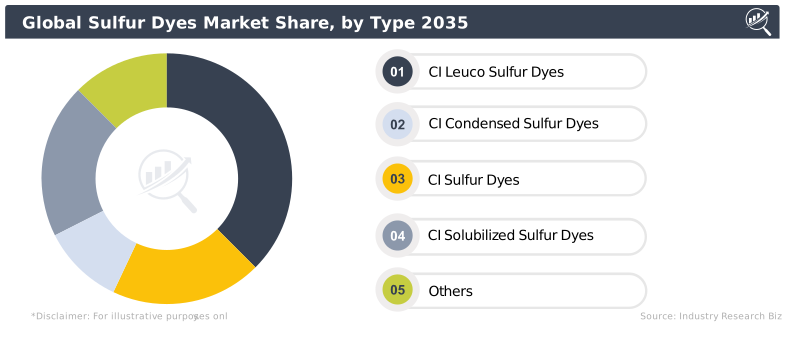
CI Leuco Sulfur Dyes: CI Leuco Sulfur Dyes hold approximately 18% of the global Sulfur Dyes Market. These dyes are widely used for cotton and cellulosic fibers because they provide improved penetration, uniform shade development, and better oxidation control during the dyeing process. Nearly 72% of their consumption comes from continuous dyeing operations, while approximately 46% of textile mills have implemented automated dosing systems to enhance color consistency. Their ability to reduce uneven dyeing makes them suitable for premium fabrics, workwear, and industrial textiles. Increasing modernization of textile dyeing facilities has further strengthened demand for these dyes in high-volume production environments.
The adoption of CI Leuco Sulfur Dyes continues to increase as textile manufacturers focus on cleaner production technologies and higher operational efficiency. Around 34% of manufacturers have introduced low-sulfide formulations to reduce wastewater contamination, while optimized dyeing processes have lowered water consumption by nearly 18%. More than 40% of export-oriented textile producers prefer these dyes for products requiring consistent color quality and compliance with international environmental standards. Continuous technological improvements in oxidation control and automated dyeing systems continue to support the expansion of this segment.
CI Condensed Sulfur Dyes: CI Condensed Sulfur Dyes account for nearly 15% of the global Sulfur Dyes Market. These dyes are recognized for their excellent color depth, high wash fastness, and strong resistance to repeated industrial laundering. Approximately 68% of their consumption is associated with woven cotton fabrics, industrial workwear, uniforms, and protective textiles. Textile manufacturers increasingly utilize these dyes because they deliver durable dark shades while maintaining production efficiency in continuous dyeing operations.
Growing demand for technical textiles has encouraged wider adoption of CI Condensed Sulfur Dyes across industrial manufacturing facilities. Around 42% of textile producers use these dyes for heavy-duty garments, while automated oxidation technologies have improved production consistency by approximately 24%. Nearly 30% of sulfur dye manufacturers continue investing in cleaner synthesis processes and improved product formulations to reduce environmental impact. Stable molecular structure and improved durability continue to support long-term demand across industrial textile applications.
CI Sulfur Dyes: CI Sulfur Dyes represent the largest segment, accounting for approximately 46% of the global Sulfur Dyes Market. Their dominance is driven by excellent compatibility with cotton fibers, economical processing costs, and outstanding wash fastness. More than 80% of cotton textile dyeing operations utilize CI Sulfur Dyes for producing black, brown, navy, and olive shades. Sulfur Black alone contributes nearly 55% of total sulfur dye consumption, making it the most widely used sulfur dye product worldwide.
The segment continues to benefit from increasing global production of denim, uniforms, industrial fabrics, and workwear. Approximately 62% of organized textile mills operate continuous dyeing systems optimized for CI Sulfur Dyes, improving productivity and reducing production time. Around 48% of manufacturers have modernized production facilities with automated oxidation and process monitoring technologies, enhancing dye fixation and reducing chemical consumption. Their combination of affordability, durability, and large-scale availability ensures continued leadership within the sulfur dyes industry.
CI Solubilized Sulfur Dyes: CI Solubilized Sulfur Dyes account for approximately 14% of the global Sulfur Dyes Market. These dyes are valued for their water-soluble properties, eliminating conventional reduction steps and simplifying textile processing. Nearly 40% of premium textile manufacturers use these dyes for specialty cotton fabrics requiring cleaner processing and improved color uniformity. Their application also supports shorter processing cycles and improved production efficiency.
Environmental sustainability has significantly increased interest in CI Solubilized Sulfur Dyes. Approximately 37% of environmentally certified textile facilities have adopted these dyes as part of cleaner manufacturing programs. Improved dye fixation has reduced color variation by around 18%, while optimized dyeing methods have lowered water consumption by approximately 15%. Increasing investment in environmentally responsible textile production and automated processing technologies is expected to strengthen demand for this product category.
Others: The Others segment accounts for approximately 7% of the global Sulfur Dyes Market. This category includes specialty sulfur dye formulations developed for customized textile applications, technical fabrics, decorative textiles, and niche industrial products. More than 50% of these specialty dyes are used in small-volume textile manufacturing where customized color shades and specific performance requirements are essential. Their versatility supports applications that cannot be fulfilled using standard sulfur dye formulations.
Manufacturers continue investing in research to improve the environmental profile and performance of specialty sulfur dyes. Around 28% of product development activities focus on advanced sulfur dye chemistry with reduced sulfide emissions and improved oxidation characteristics. Approximately 25% of recently introduced specialty sulfur dyes emphasize lower wastewater generation and improved dye utilization. Rising demand for technical textiles, protective fabrics, and customized industrial products continues creating growth opportunities for this niche segment.
By Application
Textile Industry: The Textile Industry dominates the global Sulfur Dyes Market, accounting for approximately 91% of total consumption. Sulfur dyes are extensively used for dyeing cotton and cotton-blended fabrics because they provide excellent wash fastness, deep color shades, and economical processing. More than 82% of sulfur dye usage is associated with cotton textiles, while denim manufacturing contributes nearly 30% of total textile demand. Industrial workwear, uniforms, home textiles, and protective garments remain major end-use categories supporting this segment.
The increasing expansion of textile manufacturing facilities across Asia and other developing regions continues driving sulfur dye consumption. Approximately 64% of global sulfur dye demand originates from Asia-Pacific textile production. More than 62% of organized textile processing plants have adopted continuous dyeing systems that improve productivity by approximately 24%. Nearly 45% of export-oriented textile manufacturers have upgraded to environmentally compliant dyeing technologies, supporting sustainable textile production and consistent product quality.
Others: The Others application segment accounts for approximately 9% of the global Sulfur Dyes Market. This segment includes leather processing, paper coloration, decorative products, packaging materials, and selected industrial applications. Approximately 35% of non-textile sulfur dye consumption is associated with specialty paper and packaging products requiring durable coloration, while leather processing contributes nearly 28% of this application segment. These industries value sulfur dyes for their cost-effectiveness and color durability.
Demand from non-textile industries continues to increase as manufacturers diversify sulfur dye applications beyond conventional fabric dyeing. Around 30% of producers serving these industries have expanded their product portfolios with environmentally improved sulfur dye formulations. Nearly 20% of specialty industrial applications require customized coloration with resistance to abrasion, washing, and outdoor exposure. Ongoing product innovation and increasing industrial diversification continue supporting steady development of this application segment.
Which Segment is Growing Faster?
Among the product types, CI Sulfur Dyes is the fastest-growing segment, accounting for approximately 46% of the global Sulfur Dyes Market. Its strong growth is driven by widespread use in cotton textile processing, denim manufacturing, industrial workwear, and uniforms. More than 80% of cotton dyeing applications utilize CI Sulfur Dyes because of their excellent wash fastness, deep color shades, and cost-effectiveness. Sulfur Black alone contributes nearly 55% of total sulfur dye consumption, while over 62% of organized textile mills use continuous dyeing systems optimized for CI Sulfur Dyes, supporting higher production efficiency and consistent demand.
Sulfur Dyes Market Regional Outlook
Get Comprehensive Insights into the Market’s Size and Growth Trends
Download FREE Sample North America
North America accounts for approximately 13% of the global Sulfur Dyes Market. The region benefits from highly developed textile processing infrastructure, widespread automation, and increasing demand for industrial textiles, uniforms, and protective clothing. The United States contributes nearly 78% of North American sulfur dye consumption, supported by thousands of textile manufacturing and finishing facilities. More than 45% of textile processors have adopted automated dyeing systems that improve production efficiency and reduce chemical consumption. Increasing use of sulfur black dyes in denim, military uniforms, and industrial workwear continues supporting stable market demand.
Environmental compliance remains a major characteristic of the North American market. Approximately 48% of textile dyeing facilities have implemented advanced wastewater treatment technologies, while nearly 38% operate water recycling systems to reduce freshwater consumption. Around 42% of manufacturers have introduced environmentally improved sulfur dye formulations with lower sulfide emissions. Growing demand for sustainable textile manufacturing has encouraged greater investment in digital process monitoring, improving dye utilization by approximately 20%. Continuous modernization of textile production facilities supports long-term development of the Sulfur Dyes Market Analysis, Sulfur Dyes Market Trends, and Sulfur Dyes Market Outlook across the region.
Europe
Europe holds approximately 16% of the global Sulfur Dyes Market, supported by advanced textile technologies and strong environmental regulations governing industrial chemical usage. Germany, Italy, France, Spain, and Portugal represent major textile manufacturing countries within the region. Nearly 52% of European textile manufacturers utilize environmentally certified dyeing chemicals to comply with strict sustainability standards. Demand remains particularly strong for technical textiles, automotive fabrics, industrial garments, and protective clothing requiring durable color performance.
Investment in sustainable textile processing continues to increase throughout Europe. Around 44% of textile processing facilities have adopted automated chemical dosing systems, while approximately 36% utilize water recycling technologies to minimize environmental impact. More than 40% of sulfur dye manufacturers operating within Europe have expanded production of low-sulfide dye formulations. Digital quality control systems have improved production consistency by approximately 23%, reducing product defects and enhancing operational efficiency. Continued research into environmentally responsible textile chemistry strengthens Europe's position within the Sulfur Dyes Industry Report and Sulfur Dyes Market Research Report.
Asia-Pacific
Asia-Pacific dominates the global Sulfur Dyes Market, accounting for approximately 64% of worldwide market share. China, India, Bangladesh, Vietnam, Pakistan, and Indonesia collectively represent the largest textile manufacturing hub globally. More than 70% of global cotton textile production occurs across Asia-Pacific, creating substantial demand for sulfur dyes used in denim, workwear, apparel, and home textiles. Approximately 68% of sulfur dye manufacturing facilities are located within the region, supported by integrated textile supply chains and abundant raw material availability.
Rapid industrialization and expanding textile exports continue strengthening regional demand. Nearly 62% of organized textile mills have installed continuous dyeing systems that improve productivity by approximately 24%. Around 47% of export-oriented textile manufacturers have upgraded wastewater treatment facilities to satisfy international environmental standards. Investment in automated dyeing technologies has increased significantly, improving color consistency by approximately 28% while reducing production waste. The region remains the largest contributor to the Sulfur Dyes Market Size, Sulfur Dyes Market Share, and Sulfur Dyes Market Growth, driven by expanding apparel exports and increasing domestic textile consumption.
Middle East & Africa
The Middle East & Africa account for approximately 7% of the global Sulfur Dyes Market. The market continues expanding through increasing textile manufacturing investments, industrial diversification programs, and growing domestic apparel production. Countries including Türkiye, Egypt, South Africa, and the United Arab Emirates have strengthened textile manufacturing capabilities through modernization initiatives. Nearly 35% of sulfur dye demand within the region originates from industrial textile production, while cotton processing remains a major end-use sector.
Governments across the region continue supporting industrial development through textile manufacturing initiatives and export promotion programs. Approximately 30% of large textile processing facilities have adopted modern dyeing technologies to improve production efficiency. Around 26% of manufacturers have invested in wastewater treatment systems to comply with emerging environmental regulations. Demand for uniforms, home textiles, protective garments, and industrial fabrics continues increasing as manufacturing capacity expands. Continuous investment in textile infrastructure and international trade supports future opportunities within the Sulfur Dyes Market Forecast, Sulfur Dyes Market Insights, and Sulfur Dyes Industry Analysis.
Which Region Holds the Largest Market Share?
Asia-Pacific holds the largest share of the global Sulfur Dyes Market, accounting for approximately 64% of worldwide market share. The region dominates due to its extensive textile manufacturing base, high cotton processing capacity, and strong export-oriented apparel industry. Countries such as China, India, Bangladesh, Vietnam, Pakistan, and Indonesia collectively account for more than 70% of global cotton textile production, making Asia-Pacific the largest consumer of sulfur dyes. Approximately 68% of global sulfur dye manufacturing facilities are located in the region, supported by integrated supply chains, competitive production costs, and abundant raw material availability.
List of Top Sulfur Dyes Companies
- Qingdao Sanhuan Colorchem
- ABS Laboratories
- Sinochem Tianjin
- Venus Dye Chem
Top Two Companies With Highest Share
- Qingdao Sanhuan Colorchem – Approximately 18% market share, supported by large-scale sulfur dye manufacturing, extensive export operations, and a broad portfolio of sulfur black and specialty sulfur dyes.
- Sinochem Tianjin – Approximately 14% market share, driven by integrated chemical manufacturing capabilities, diversified sulfur dye production, and strong distribution across Asia-Pacific and international textile markets.
Investment Analysis and Opportunities
The Sulfur Dyes Market continues to attract investments as textile manufacturers expand production capacity and modernize dyeing facilities to improve operational efficiency. More than 62% of new investments are directed toward Asia-Pacific due to its large textile manufacturing base and integrated supply chain. Approximately 48% of sulfur dye producers have upgraded automated production lines to improve product consistency and reduce manufacturing waste. Nearly 40% of investment projects focus on environmentally compliant manufacturing technologies, including wastewater treatment systems, low-sulfide processing, and energy-efficient production equipment.
Growing demand for sustainable textile chemicals continues creating attractive investment opportunities. Around 35% of textile processing companies are investing in automated dye dosing systems to improve dye utilization and reduce chemical consumption. Approximately 30% of new product investments are focused on liquid sulfur dyes and solubilized sulfur dye formulations compatible with continuous dyeing operations. Investments in digital process monitoring have improved production efficiency by nearly 22%, while water recycling technologies have reduced industrial water usage by approximately 25%.
New Product Development
Product innovation within the Sulfur Dyes Market is increasingly focused on sustainability, improved color performance, and operational efficiency. More than 40% of recent product launches involve low-sulfide sulfur dye formulations designed to reduce wastewater contamination while maintaining excellent wash fastness. Manufacturers are introducing pre-reduced liquid sulfur dyes that simplify textile processing and improve compatibility with automated dyeing systems. Liquid sulfur dyes now represent approximately 53% of newly introduced sulfur dye products because they reduce processing complexity and improve dosing accuracy.
Manufacturers are also investing in bio-based intermediates, recyclable dye systems, and advanced sulfur dye chemistry to meet growing sustainability requirements. Several newly introduced sulfur dye products support laser-compatible denim finishing and low-impact textile processing. Water-saving dye technologies have demonstrated reductions of up to 50% in water consumption compared with conventional sulfur dyeing methods.
Five Recent Developments
- 2023: Qingdao Sanhuan Colorchem expanded sulfur dye production capacity by approximately 20,000 metric tons through the addition of environmentally optimized manufacturing facilities to improve supply for textile manufacturers.
- 2023: Archroma introduced advanced sulfur dye solutions derived from recycled and agricultural waste materials while expanding sustainable sulfur dye technologies for textile coloration.
- 2024: Sinochem Tianjin launched new solubilized sulfur dye formulations capable of reducing textile processing time by approximately 25%, with adoption across more than 100 textile mills.
- 2024: Shree Pushkar Chemicals & Fertilisers expanded sulfur derivative manufacturing capacity in India to strengthen the supply of high-purity sulfur dye intermediates for textile chemical production.
- 2025: Leading sulfur dye manufacturers expanded production of pre-reduced liquid sulfur dyes capable of reducing water consumption by up to 50% while lowering sulfide content during textile dyeing operations.
Report Coverage of Sulfur Dyes Market
The Sulfur Dyes Market Report provides comprehensive analysis of industry performance across product types, applications, regional markets, competitive landscape, manufacturing trends, and technological developments. The report evaluates 5 major product categories, 2 primary application segments, and 4 key regional markets to provide a complete assessment of global industry performance. More than 20 leading manufacturers are analyzed based on production capabilities, product portfolios, expansion strategies, and competitive positioning.
The study further covers investment trends, supply chain developments, sustainability initiatives, product innovation, and manufacturing modernization influencing the sulfur dyes industry. It includes detailed assessment of textile manufacturing demand, cotton processing trends, industrial fabric production, and export-oriented apparel manufacturing. Environmental regulations, wastewater management technologies, automation in textile dyeing, and digital manufacturing practices are also analyzed to provide actionable business intelligence.
Sulfur Dyes Market Report Coverage
| REPORT COVERAGE | DETAILS | |
|---|---|---|
|
Market Size Value In |
USD 570.3 Million in 2026 |
|
|
Market Size Value By |
USD 873.41 Million by 2035 |
|
|
Growth Rate |
CAGR of 4.85% from 2026-2035 |
|
|
Forecast Period |
2026 - 2035 |
|
|
Base Year |
2025 |
|
|
Historical Data Available |
Yes |
|
|
Regional Scope |
Global |
|
|
Segments Covered |
By Type :
By Application :
|
|
|
To Understand the Detailed Market Report Scope & Segmentation
Download FREE Sample
|
||
Frequently Asked Questions
The global Sulfur Dyes Market is expected to reach USD 873.41 Million by 2035.
The Sulfur Dyes Market is expected to exhibit a CAGR of 4.85% by 2035.
Qingdao Sanhuan Colorchem,ABS Laboratories,?,Sinochem Tianjin,Venus Dye Chem
In 2025, the Sulfur Dyes Market value stood at USD 543.92 Million.

Related Reports

Our Clients






























.svg)
