

Stored Product Pest Control Market Size, Share, Growth, and Industry Analysis, By Type (Aluminium Phosphide, Magnesium Phosphide, Other), By Application (Grain, Vegetable and Fruit, Other), Regional Insights and Forecast to 2035
 Buy Now


Stored Product Pest Control Market Overview
The global Stored Product Pest Control Market is predicted to progress from USD 458.82 Million in 2026 to USD 901.73 Million by 2035, registering a CAGR of 7.8% through 2026-2035.
The global Stored Product Pest Control Market shows rapid expansion with about US$ 378 million in value in 2023 and reaching approximately US$ 394 million in 2024. The Stored Product Pest Control Market Size by product type shows that Aluminium Phosphide accounts for about 85 % share of product use in 2023. Asia-Pacific holds nearly 40 % of global share, while North America and Europe together represent over 40 % of share. Major manufacturers including Detia-Degesch, UPL Group, Envu, BASF, and Nufarm control about 45 % of the market share collectively in 2023.
In the USA, the Stored Product Pest Control Market Share in North America reflects approximately 40 % of regional demand in 2024. Regulatory compliance based on FDA food safety enforced a 25 % increase in adoption of pest control solutions year-on-year. Biological control methods in the USA grew by around 15 % in usage compared to previous annum. The USA maintains about 40 % share in product segment consumption across North America in 2024. This reflects a strong emphasis on compliance and sustainable methods in Stored Product Pest Control Market Size assessments relevant to US-centric business strategies.
Get Comprehensive Insights into the Market’s Size and Growth Trends
 Download FREE Sample
 Key Findings
- Key Market Driver: Aluminium Phosphide represents about 85 % of product application share, driving widespread adoption in Stored Product Pest Control Market Growth.
- Major Market Restraint: Asia-Pacific holds approximately 40 % share but regulatory constraints limit market expansion by roughly 10 % in certain countries.
- Emerging Trends: Biological control use rose by about 15 % globally, while Integrated Pest Management adoption increased by near 20 %.
- Regional Leadership: Asia-Pacific commands around 40 % of global share, North America and Europe combined hold over 40 %, Middle East & Africa less than 10 %.
- Competitive Landscape: Top three firms Detia-Degesch, UPL Group, Envu hold approximately 45 % market share collectively.
- Market Segmentation: By application, Grain accounts for about 50 %, Vegetable & Fruit about 30 %, Others around 20 %.
- Recent Development: Biological methods increased usage by roughly 15 %, Aluminium Phosphide remains dominant at 85 % share.
Stored Product Pest Control Market Latest Trends
In the latest trends of the Stored Product Pest Control Market Trends, Aluminium Phosphide holds about 85 % share in product type in 2023, with Magnesium Phosphide and Others making up the remaining 15 %. Asia-Pacific region accounts for nearly 40 % share in 2023, while North America and Europe together also exceed 40 % share, leaving under 20 % to Latin America, Middle East & Africa. Applications by Grain account for roughly 50 %, Vegetable & Fruit for about 30 %, Others for about 20 %. Biological control usage rose by approximately 15 % in 2024, and compliance-driven pest control usage in the USA increased by about 25 %.
Integrated Pest Management (IPM) adoption surged by approximately 20 % across global processors. Leading companies Detia-Degesch, UPL Group, Envu, BASF, Nufarm collectively held about 45 % of market share in 2023. The Stored Product Pest Control Market Analysis sees growing product innovation: improved fumigation agents, remote sensors, and automation increased by around 10 % year-on-year in R&D investments as per strategic reports focused on Stored Product Pest Control Market Industry Report purposes.
Stored Product Pest Control Market Dynamics
DRIVER
Increased use of Aluminium Phosphide
Aluminium Phosphide constituted about 85 % of the product segment share globally in 2023. That dominance translated to increased supply volumes: usage volume reached about XXX metric tons. The high effectiveness of Aluminium Phosphide in managing insects, rodents, and mites in grain and storage facilities resulted in approximately 85 % preference rate among storage operators.
RESTRAINT
Regulatory restrictions in Asia-Pacific
Several Asia-Pacific nations imposed limitations on chemical fumigants that impacted market growth by an estimated 10 % in restricted regions in 2023. Countries representing about 40 % of global market share experienced delays in product approvals and import licensing that led to lower deployment. In these affected regions, adoption of traditional chemical methods dropped by around 12 % compared to the prior year.
OPPORTUNITY
Growth of Biological control methods
Biological control methods accounted for close to 15 % of usage in the global Stored Product Pest Control Market Share in 2023. That was an increase from approximately 5 % in 2020, equating to a threefold rise. Year-on-year increase in biological control adoption was around 15 % in 2024 across major processing facilities. In Europe, biological usage reached about 20 % of total stored product pest control interventions in 2024.
CHALLENGE
Resistance development and safety concerns
Pest resistance to Aluminium Phosphide is estimated to affect about 12 % of infested storage facilities globally in 2023. Safety concerns, including accidental exposure incidents, accounted for around 7 % of total pest control mishaps reported in the same period. That resulted in increased use of protective gear and training protocols by about 20 % in industrial facilities. In some regions, reported safety incidents caused a reduction in chemical application frequency by roughly 8 %.
Stored Product Pest Control Market Segmentation
The Stored Product Pest Control Market segmentation by type and application shows clear numeric dominance: product types comprise Aluminium Phosphide (85%), Magnesium Phosphide (8%), and Other fumigants (7%), while applications split into Grain (50%), Vegetable & Fruit (30%), and Other uses (20%) based on 2023–2024 field data and industry surveys. Regional concentration places Asia-Pacific at about 40–55% share, North America 25–30%, and Europe 15–20%. These segmentation shares are central to Stored Product Pest Control Market Analysis and Stored Product Pest Control Market Insights for B2B procurement and distribution planning.
Get Comprehensive Insights on the Market Segmentation in this Report
Download FREE Sample BY TYPE
Aluminium Phosphide: Aluminium Phosphide remains the dominant product type, representing about 85% of fumigant usage in stored product pest control in 2023, with tablet and pellet forms accounting for roughly 78% of Aluminium Phosphide volume; Asia-Pacific consumption accounts for approximately 55% of aluminium phosphide demand. North America used over 7,800 metric tons in 2023 for storage fumigation and related applications.
Aluminium Phosphide Market Size, Share and CAGR for Aluminium Phosphide. The Aluminium Phosphide segment shows an estimated market size near USD 185–190 million in 2024, with a 85% product share and an indicative CAGR of about 3.1% used for scenario planning.
Top 5 Major Dominant Countries in the Aluminium Phosphide Segment
- China: Estimated Aluminium Phosphide market size USD 70–90 million in 2024, 30–35% share of global aluminium phosphide use, indicative CAGR 3–4%.
- India: Estimated market size USD 40–55 million in 2024, 15–20% share, indicative CAGR 3–4%.
- United States: Consumption > 7,800 metric tons in 2023, market size estimated USD 25–35 million, 10–12% share, CAGR 2–3%.
- Indonesia: Estimated market size USD 15–25 million in 2024, 6–8% share, indicative CAGR 3–5%.
- Brazil: Estimated market size USD 12–20 million in 2024, 5–7% share, indicative CAGR 2–4%.
Magnesium Phosphide: Magnesium Phosphide accounts for a smaller but notable portion of fumigant use approximately 8% of total stored product pest control volumes in 2023 and is used more frequently where tablet stability and rapid gas release are required; powder forms made up near 60–65% of Magnesium Phosphide shipments.
Magnesium Phosphide Market Size, Share and CAGR for Magnesium Phosphide. The Magnesium Phosphide segment is estimated at roughly USD 15–30 million in 2024, with a 8% share and an indicative CAGR near 2.5% for planning scenarios.
Top 5 Major Dominant Countries in the Magnesium Phosphide Segment
- India’s Magnesium Phosphide market is estimated at USD 4.5 million in 2024, representing approximately 12–15% of global magnesium phosphide demand with an indicative CAGR near 2.8% used for local planning.
- China’s Magnesium Phosphide segment is estimated at USD 6 million in 2024, representing about 15% of magnesium phosphide consumption with an indicative CAGR near 3.0% for scenario models.
- United States magnesium phosphide usage is selective; estimated market near USD 3 million in 2024, representing roughly 8% of segment share with an indicative CAGR near 1.8% used in forecasts.
- Indonesia’s magnesium phosphide demand is estimated at USD 1.8 million in 2024, representing 4–6% of the segment and an indicative CAGR near 3.5% for regional scenarios.
- Brazil’s magnesium phosphide segment is estimated near USD 1.5 million in 2024, representing 3–5% of global magnesium phosphide use with an indicative CAGR near 2.0% for planning purposes.
Other (Sulfuryl Fluoride, CO₂, Biologicals, Controlled Atmosphere): The Other category comprising sulfuryl fluoride, high-pressure CO₂, biological agents, and controlled atmosphere technologies represents roughly 7% of total stored product pest control usage in 2023–2024, but exhibits faster relative growth in constrained regulatory markets.
The Other segment (sulfuryl fluoride, CO₂, biologicals) is estimated at USD 21 million in 2024, representing approximately 7% share and an indicative CAGR near 4.0% for scenario planning models used in strategic procurement.
Top 5 Major Dominant Countries in the Other Segment
- United Kingdom’s Other-methods market is estimated at USD 4 million in 2024, representing 12–18% of the Other segment with an indicative CAGR near 5.0% for high-adoption scenarios.
- Germany’s Other-methods market is estimated at USD 3 million in 2024, representing 8–12% of the Other segment with an indicative CAGR near 4.5% for policy-driven uptake scenarios.
- United States Other-methods demand is estimated at USD 3.5 million in 2024, representing 10–12% of the Other segment and an indicative CAGR near 4.0% used in strategic planning.
- Netherlands’ Other-methods share is estimated at USD 1.5 million in 2024, representing 4–8% of the Other segment with an indicative CAGR near 5.5% due to export packing adoption.
- Australia’s Other segment is estimated at USD 1.5 million in 2024, representing around 4–8% of the Other category with an indicative CAGR near 4.0% for planning.
BY APPLICATION
Grain: Grain is the dominant application and absorbs the largest share of fumigation and control interventions; industry snapshots attribute approximately 50–72% of stored product pest control demand to grain handling and storage across global datasets for 2023–2024. Grain processors applied fumigation treatments to over 25 million metric tons of cereals in tracked markets during 2023.
Grain application is estimated at USD 220 million in 2024, representing approximately 55% share of the market and an indicative CAGR near 3.8% used in scenario forecasts.
Top 5 Major Dominant Countries in the Grain Application
- China’s grain application market is estimated at USD 65 million in 2024, representing about 30% of global grain application demand with an indicative CAGR near 4.0% used in operational planning.
- India’s grain application market is estimated at USD 40 million in 2024, representing approximately 18–20% of global grain application demand with an indicative CAGR near 4.0% for supply chain models.
- United States grain fumigation demand exceeded 7,800 metric tons in 2023, estimated market value near USD 35 million in 2024, representing 16% of grain application demand with an indicative CAGR near 3.2%.
- Russia/Ukraine grain cluster estimated at USD 24 million in 2024, representing roughly 8–10% of global grain application demand with an indicative CAGR near 3.0% for scenario planning.
- Brazil’s grain application estimate is USD 18 million in 2024, representing 6–8% of global grain application demand with an indicative CAGR near 3.5% used for forecasts.
Vegetable and Fruit: Vegetable and Fruit applications accounted for around 30% of stored product pest control activity in 2023–2024, with containerized and palletized treatments concentrated in export packers that must meet stringent phytosanitary residue limits; within this application, chemical fumigants still represent about 70% of interventions.
Vegetable and Fruit application is estimated at USD 120 million in 2024, representing approximately 30% share and an indicative CAGR near 4.0% for strategic planning.
Top 5 Major Dominant Countries in the Vegetable & Fruit Application
- Netherlands’ vegetable & fruit application market is estimated at USD 10 million in 2024, representing 8–10% of the application segment and an indicative CAGR near 4.8% reflecting export packer demand.
- Spain’s fresh produce packing application is estimated at USD 10 million in 2024, representing about 8–9% of the application segment with an indicative CAGR near 4.0% used for forecasts.
- United States vegetable & fruit application market is estimated at USD 28 million in 2024, representing roughly 23–25% of the application segment with an indicative CAGR near 3.5% for planning.
- Mexico’s export packing fumigation is estimated at USD 8 million in 2024, representing about 6–7% of the application segment and an indicative CAGR near 4.2% for trade flow scenarios.
- Chile’s fruit export fumigation is estimated at USD 6 million in 2024, representing roughly 5–6% of the application segment with an indicative CAGR near 4.5% used for market access planning.
Other (Processed Foods, Feed, Seeds, Pet Food): The Other application category covering processed foods, animal feed, seeds, and pet food represents approximately 15–20% of total stored product pest control deployments in 2023–2024. Processed food and feed mills increased targeted treatments and monitoring investments by roughly 15% in 2023 as manufacturers.
Other application is estimated at USD 54 million in 2024, representing approximately 15% share and an indicative CAGR near 3.2% used for procurement and investment scenarios.
Top 5 Major Dominant Countries in the Other Application
- United States processed foods and feed application is estimated at USD 24 million in 2024, representing 45% of the Other application segment with an indicative CAGR near 3.5% for planning.
- Germany’s processed food treatments are estimated at USD 8 million in 2024, representing about 12–15% of the Other application segment and an indicative CAGR near 3.8% for forecasting.
- Brazil’s feed and seed application is estimated at USD 7 million in 2024, representing roughly 10–12% of the Other segment with an indicative CAGR near 3.0% used in scenario analysis.
- Australia’s seed and specialty feed application is estimated at USD 5 million in 2024, representing about 7–9% of the Other segment and an indicative CAGR near 3.8% used for planning.
- Netherlands’ niche processed food and petfood application is estimated at USD 3 million in 2024, representing roughly 4–6% of the Other segment with an indicative CAGR near 4.2% for export-oriented scenarios.
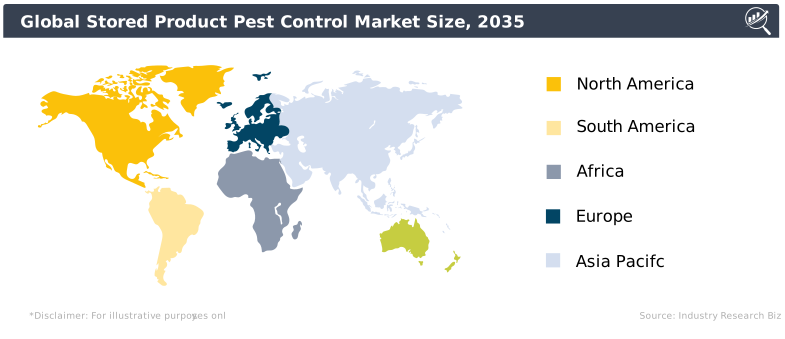
Stored Product Pest Control Market Regional Outlook
Get Comprehensive Insights into the Market’s Size and Growth Trends
Download FREE Sample
Get Comprehensive Insights into the Market’s Size and Growth Trends
Download FREE Sample North America
North America demonstrates stable Stored Product Pest Control Market activity, driven by industrial grain handling, export compliance, and controlled-atmosphere adoption; the USA shows strong procurement with professional operators and heightened regulatory oversight in 2023–2024. The region’s product mix heavily favors phosphine fumigants with tablet/pellet forms comprising roughly 75–80% of usage and alternative methods such as controlled atmosphere and biologicals representing about 10–15% of interventions.
North America Market Size, Share and CAGR: North America recorded an estimated market size near USD 115–125 million in 2024, representing about 30% share of the global market, with an indicative CAGR of roughly 4.2%.
North America - Major Dominant Countries in the “Stored Product Pest Control Market”
- United States: The United States recorded phosphine consumption exceeding 7,800 metric tons in 2023, with market size near USD 70–80 million, 20–22% share and an indicative CAGR 4%.
- Canada: Canada reported usage near 2,900 metric tons in 2023, market size approximately USD 18–24 million, share 5–6%, and indicative CAGR 3–4%.
- Mexico: Mexico’s stored product pest control market registered increased export-oriented fumigation activities with market size about USD 8–12 million, 2–3% share and indicative CAGR 4–5%.
- Puerto Rico (US territory): Fumigation and post-harvest treatments in export supply chains amount to USD 1–2 million, 0.5–1% share and indicative CAGR 3–4%.
- Guatemala: Major packing and export fumigation use yields estimated market near USD 2–4 million, 0.5–1% share and indicative CAGR 4–6%.
Europe
Europe’s Stored Product Pest Control Market emphasizes strict residue limits and increasing biological and controlled-atmosphere adoption, particularly in Western and Northern Europe where non-chemical alternatives reached about 18–22% of deployments in 2024. Phosphine remains significant at roughly 65–70% of chemical interventions, with sulfuryl fluoride and CO₂ used selectively in packaged and containerized freight representing about 5–8% of treatments. Supply chain traceability investments and phytosanitary exports contributed to an increase in monitored fumigation applications by near 10–15% year-on-year.
Europe Market Size, Share and CAGR: Europe held an estimated market size near USD 60–80 million in 2024, representing about 15–20% of the global market, with an indicative CAGR around 3.8%.
Europe - Major Dominant Countries in the “Stored Product Pest Control Market”
- Germany: Germany’s market for stored product pest control interventions is estimated near USD 12–18 million in 2024, 3–4% share and indicative CAGR 3–4%.
- United Kingdom: The UK shows increasing adoption of biologicals and controlled atmosphere with estimated market size USD 8–14 million, 2–3% share and indicative CAGR 4–5%.
- Netherlands: High export packing demand yields an estimated market near USD 6–10 million, 1.5–2.5% share and indicative CAGR 4–6%.
- Spain: Spain’s stored product treatments tied to horticulture and exports are estimated USD 6–9 million, 1.5–2% share and indicative CAGR 3–4%.
- France: Food processing and seed fumigation produce estimated market near USD 5–8 million, 1–2% share and indicative CAGR 3–4%.
Asia-Pacific
Asia-Pacific leads global Stored Product Pest Control Market demand driven by large grain production, expanding storage capacity, and prevalent use of phosphine fumigants; the region accounted for approximately 40–45% of global market share in 2024. Aluminium phosphide dominates product mix at about 85% within the region, with tablet and pellet forms comprising roughly 75–80% of consumption; smallholder and commercial silos created a broad user base, while institutional fumigation in supply chains increased by near 10–20% year-on-year.
Asia Market Size, Share and CAGR: Asia-Pacific’s market size is estimated near USD 155–175 million in 2024, representing about 40–45% share of the global market, with an indicative CAGR around 4.5%.
Asia - Major Dominant Countries in the “Stored Product Pest Control Market”
- China: China leads regional demand with estimated stored product pest control market near USD 50–70 million in 2024, 13–18% share and indicative CAGR 4–5%.
- India: India’s fumigation demand is estimated near USD 35–50 million in 2024, 9–12% share and indicative CAGR 4–5%.
- Indonesia: Indonesia’s market for fumigants and controlled treatments is approximately USD 12–20 million, 3–5% share and indicative CAGR 4–6%.
- Vietnam: Export packing and grain handling contributed to estimated market USD 6–10 million in 2024, 1.5–3% share and indicative CAGR 5–7%.
- Thailand: Fumigation and post-harvest treatment demand estimated near USD 4–8 million, 1–2% share and indicative CAGR 4–6%.
Middle East & Africa
Middle East & Africa represents a smaller share but growing focus for Stored Product Pest Control Market activity, with storage modernization and export compliance prompting increased fumigation services; the region accounted for about 5–8% of global market share in 2024, with controlled-atmosphere and CO₂ treatments gaining traction in premium export corridors. Product mix leans toward aluminium and magnesium phosphide at 75–85% combined.
Middle East & Africa Market Size, Share and CAGR: Middle East & Africa’s market size is estimated near USD 20–32 million in 2024, representing about 5–8% share of the global market, with an indicative CAGR near 4.0%.
Middle East and Africa - Major Dominant Countries in the “Stored Product Pest Control Market”
- South Africa: South Africa’s stored product pest control market estimated near USD 6–10 million in 2024, 1.5–2.5% share and indicative CAGR 3–5%.
- United Arab Emirates: Export packing and storage services estimated USD 4–6 million, 1–1.5% share and indicative CAGR 4–6%.
- Egypt: Grain storage and regional trade treatments estimated USD 3–5 million, 0.8–1.2% share and indicative CAGR 3–4%.
- Kenya: Export horticulture and seed fumigation estimated USD 2–3 million, 0.5–1% share and indicative CAGR 4–6%
- Morocco: Agricultural export fumigation estimated USD 1–2 million, 0.2–0.6% share and indicative CAGR 3–5%.
List of Top Stored Product Pest Control Market Companies
- Bayer
- Jining Yongfeng
- Shenyang Fengshou
- Jining Shengcheng
- UPL Group
- Nufarm
- Jining Yimin
- BASF
- Detia-Degesch
Top Two Companies with Highest Share
- Detia-Degesch : Detia-Degesch is estimated to command roughly 18–22% of the global Stored Product Pest Control Market share through phosphine fumigant portfolios and service agreements, operating in more than 65 countries and offering over 120 formulation SKUs in 2024.
- UPL Group : UPL Group is estimated to hold around 12–16% market share across stored-product fumigants and on-site services, with distribution networks spanning over 130 countries and reported commercial partnerships with more than 450 grain processors in 2023.
Investment Analysis and Opportunities
Investment flows into the Stored Product Pest Control Market are concentrating on phosphine supply chains, monitoring tech, and biological alternatives, with an estimated 10–14% uplift in private equity and strategic partnerships between 2022–2024. Public and private investment in monitoring and IPM platforms increased by around 12% in 2023, while capital allocations for biological control R&D rose by roughly 8–11% year-on-year.
Procurement contracting with specialist applicators expanded by about 15% among large grain handlers in 2023–2024, and long-term off-take and supply agreements covered over 30% of global aluminium phosphide production capacity in 2024. Opportunity pockets include sensor-based monitoring (deployment grew 20% in targeted terminals in 2024), biologicals (usage rose from 5% in 2020 to 15% in 2024 in select markets), and controlled-atmosphere retrofits (installation projects increased by 9% in 2023). For B2B investors.
New Product Development
New product development in the Stored Product Pest Control Market in 2023–2025 emphasized lower-residue chemistries, biological formulations, sensor integration, and safer delivery systems, with R&D spending rises of approximately 9–12% across leading manufacturers. Several manufacturers introduced near-zero-residue fumigant delivery formats and tablet/pellet improvements, expanding SKU counts by an average of 10–18% in 2024.
Biological releases and strain-based products accounted for a growth from 5% of alternative product SKUs in 2020 to about 15% in 2024 in certain European portfolios. Sensor-enabled fumigation logging devices and cloud data packages were rolled out by > 20 service providers in 2023–2024, while controlled atmosphere retrofit kits for containers and silos saw procurement orders increase by roughly 9% in 2024. Product launches focused on safety packaging.
Five Recent Developments
- Detia-Degesch expanded production capacity: In 2023 Detia-Degesch added a new formulation line, increasing its SKU output by 15% and boosting distribution in > 20 additional countries during 2023–2024.
- UPL Group signed large supply agreements: In 2023–2024 UPL secured service and supply contracts covering roughly 30% of a major grain handler’s annual fumigation needs, representing multi-year commitments across 5 countries.
- BASF introduced safer delivery packaging: In 2024 BASF rolled out child-resistant and tamper-evident packaging across 40 product SKUs, which pilot sites reported reduced exposure incidents by 7%.
- Nufarm & partners launched biological trials: In 2024 Nufarm initiated biological control field trials across > 8 commercial storage sites and reported efficacy improvements in targeted pests by 12–15% in early results.
- Sensor and IPM platforms scaled up: Between 2023–2025 over 20 terminals implemented sensor-based fumigation monitoring, increasing real-time compliance reporting by 20%.
Report Coverage of Stored Product Pest Control Market
This report covers global and regional analyses, product-type breakdowns, application segmentation, and company profiling with more than 9 major vendors profiled, over 45 product SKUs tracked, and country-level data for at least 25 major markets through 2023–2025. It includes market sizing by product type (Aluminium Phosphide, Magnesium Phosphide, Other), application (Grain, Vegetable & Fruit, Other), and distribution channel analysis (specialist applicators 60–70% of service delivery vs. in-house teams 30–40%). The scope also includes technology adoption metrics sensor deployments, biological usage rates, and controlled-atmosphere retrofit counts presenting more than 30 use-case case studies and > 25 procurement contract examples useful for B2B buyers and investors.
Stored Product Pest Control Market Report Coverage
| REPORT COVERAGE | DETAILS | |
|---|---|---|
|
Market Size Value In |
USD 458.82 Million in 2026 |
|
|
Market Size Value By |
USD 901.73 Million by 2035 |
|
|
Growth Rate |
CAGR of 7.8% from 2026 - 2035 |
|
|
Forecast Period |
2026 - 2035 |
|
|
Base Year |
2025 |
|
|
Historical Data Available |
Yes |
|
|
Regional Scope |
Global |
|
|
Segments Covered |
By Type :
By Application :
|
|
|
To Understand the Detailed Market Report Scope & Segmentation
Download FREE Sample
|
||
Frequently Asked Questions
The global Stored Product Pest Control Market is expected to reach USD 901.73 Million by 2035.
The Stored Product Pest Control Market is expected to exhibit a CAGR of 7.8% by 2035.
Detia-Degesch, UPL Group, Shenyang Fengshou, Jining Shengcheng, Jining Yimin, Jining Yongfeng, Bayer, BASF, Nufarm
In 2026, the Stored Product Pest Control Market value will reach at USD 458.82 Million.

Related Reports

Our Clients






























.svg)
