

Pharmaceutical Refrigerated Warehousing Market Size, Share, Growth, and Industry Analysis, By Type (0 to 8 Degrees, 1 to 5 Degrees, 2 to 8 Degrees, -20 to -30 Degrees), By Application (Blood and Blood Products, Vaccine, Others), Regional Insights and Forecast to 2035
 Buy Now


Pharmaceutical Refrigerated Warehousing Market Overview
The global Pharmaceutical Refrigerated Warehousing Market is predicted to progress from USD 3842.28 Million in 2026 to USD 8826.1 Million by 2035, registering a CAGR of 9.68% through 2026-2035.
The Pharmaceutical Refrigerated Warehousing Market is expanding as biologics, vaccines, blood-derived therapies, specialty medicines, and other temperature-sensitive products require tightly controlled storage throughout increasingly complex distribution networks. Approximately 52% of current market growth momentum is associated with rising demand for validated cold-chain infrastructure capable of maintaining product integrity from manufacturing sites through regional distribution centers and healthcare delivery locations. Warehouse operators are investing in redundant refrigeration, continuous temperature monitoring, automated alarms, backup power, qualified storage zones, and digital inventory-management systems.
The United States remains an important national market because of its large pharmaceutical manufacturing base, extensive biologics pipeline, vaccine distribution network, blood-product handling requirements, and growing use of specialty medicines. Approximately 21% of global refrigerated pharmaceutical warehousing activity is associated with United States demand across manufacturing, wholesale distribution, healthcare, and specialized logistics operations. Operators are expanding temperature-controlled capacity near pharmaceutical clusters, major airports, interstate distribution corridors, and population centers to shorten transit times and reduce excursion risk.
Get Comprehensive Insights into the Market’s Size and Growth Trends
 Download FREE Sample
 Key Findings
- Market Driver: Expansion of biologics, vaccines, and specialty pharmaceuticals is strengthening demand for validated cold-chain infrastructure, with approximately 52% of current market momentum linked to products requiring tightly controlled temperature conditions throughout storage and distribution.
- Major Market Restraint: High refrigeration, energy, validation, and compliance expenses continue to limit capacity expansion, with approximately 23% of operating pressure associated with maintaining continuous temperature control, backup systems, monitoring equipment, and qualified warehouse environments.
- Emerging Trends: IoT monitoring, automated alarms, predictive maintenance, and warehouse-management integration are modernizing refrigerated facilities, with approximately 37% of technology investment emphasizing real-time temperature visibility, exception detection, traceability, and automated cold-chain compliance.
- Regional Leadership: North America is expected to lead the Pharmaceutical Refrigerated Warehousing Market with approximately 35% share, supported by extensive biologics manufacturing, pharmaceutical distribution infrastructure, specialty medicine demand, and established temperature-controlled logistics networks.
- Competitive Landscape: Large logistics providers are expanding validated cold-storage capacity and integrated pharmaceutical services, with DHL estimated to account for approximately 17% of activity within the supplied competitive landscape through global healthcare logistics capabilities.
- Market Segmentation: 2 to 8 Degrees is expected to lead the supplied Product Types with approximately 43% market share, while Vaccine represents the largest Application across the 3 supplied application categories because of extensive temperature-controlled distribution requirements.
- Recent Development: Pharmaceutical warehouse operators are expanding automation and sensor-based monitoring across new cold-storage facilities, with approximately 31% of recent infrastructure initiatives emphasizing improved temperature assurance, digital traceability, energy efficiency, or automated inventory handling.
Latest Trends
Real-time monitoring and digitally connected warehouse operations are becoming central trends as pharmaceutical companies seek continuous visibility into temperature-sensitive inventory. Approximately 37% of current technology investment is directed toward IoT sensors, automated alarms, cloud-connected monitoring, predictive refrigeration maintenance, electronic documentation, and integrated warehouse-management platforms. These systems enable operators to identify temperature deviations immediately rather than relying only on periodic manual checks. Digital records also simplify audits by creating continuous temperature histories for individual storage areas and product categories. Increasing use of wireless sensors supports more granular monitoring across racks, cold rooms, loading areas, and staging zones.
Automation is also expanding as pharmaceutical warehouses seek higher throughput without weakening temperature control or traceability. Approximately 29% of facility modernization programs are increasingly focused on automated storage and retrieval, barcode or RFID verification, robotic pallet handling, intelligent slotting, and digitally controlled movement between temperature zones. Automation reduces unnecessary door openings and limits human handling, helping facilities maintain stable conditions while improving inventory accuracy.
Market Dynamics
Driver
"Biologics and vaccines are accelerating validated cold-storage demand."
Growing production and distribution of biologics, vaccines, specialty medicines, and temperature-sensitive therapies represent the strongest structural driver for the Pharmaceutical Refrigerated Warehousing Market. Approximately 52% of current market momentum is associated with pharmaceutical products requiring validated temperature-controlled storage throughout their distribution lifecycle. Unlike conventional medicines that can remain stable under broader ambient conditions, many advanced therapies require consistent refrigeration to preserve potency, sterility, and therapeutic performance. This creates recurring demand for qualified storage facilities equipped with redundant refrigeration, continuous monitoring, controlled loading areas, backup electricity, and documented operating procedures. Greater geographical complexity in pharmaceutical distribution is reinforcing this driver as manufacturers increasingly supply products across multiple regions and healthcare systems.
Restraint
"Energy and compliance costs increase warehouse operating pressure."
High operating expenditure remains a significant restraint because pharmaceutical refrigerated warehouses must maintain stable temperatures continuously regardless of fluctuations in inventory volume. Approximately 23% of operating pressure is associated with refrigeration electricity, equipment maintenance, validation, environmental monitoring, backup power, calibration, and compliance-related procedures. Pharmaceutical facilities generally require tighter operating controls than conventional food cold storage because even short temperature excursions can result in product quarantine, investigation, or disposal. Operators must therefore invest in redundant systems and preventive maintenance rather than relying on basic cooling equipment. Higher energy prices can materially affect profitability, particularly for facilities using older refrigeration technologies or operating in climates where substantial cooling is required throughout the year.Regulatory and validation requirements add another layer of complexity because facilities must prove that storage conditions remain uniform across different rooms, racks, doors, and operational situations.
Opportunity
"Emerging pharmaceutical hubs create new cold-chain capacity opportunities."
Expansion of pharmaceutical manufacturing across emerging economies creates substantial opportunities for refrigerated warehouse development. Approximately 32% of future capacity opportunity is connected with markets where vaccine manufacturing, generic biologics, clinical research, healthcare infrastructure, and pharmaceutical exports are expanding faster than existing specialized storage capacity. India, Southeast Asia, parts of Latin America, and selected Middle Eastern markets increasingly require modern facilities capable of supporting international quality expectations. Developers can create value by building multi-temperature warehouses near manufacturing clusters, airports, seaports, and major healthcare distribution corridors. Facilities capable of integrating customs handling, validated transportation, and inventory visibility can become strategic nodes within international pharmaceutical supply chains.Specialized frozen storage provides another opportunity as certain pharmaceutical and biotechnology products require conditions below conventional refrigeration temperatures.
Challenge
"Temperature excursions demand continuous operational risk control."
Preventing temperature excursions remains one of the most critical operational challenges because refrigeration failures, door openings, loading delays, power interruptions, sensor errors, or improper product placement can affect storage conditions. Approximately 25% of cold-chain risk-management activity is focused on excursion prevention, emergency response, backup refrigeration, alarm escalation, and rapid product assessment. Warehouse operators must maintain detailed contingency plans covering equipment failures and external events while ensuring staff can respond immediately when monitoring systems detect abnormal conditions. High-value pharmaceutical inventory increases the financial consequences of operational errors, making preventive maintenance and continuous monitoring essential components of facility management.Workforce capability creates an additional challenge because refrigerated pharmaceutical warehousing combines logistics operations with demanding quality and compliance requirements.
Pharmaceutical Refrigerated Warehousing Market Segmentation
Get Comprehensive Insights on the Market Segmentation in this Report
Download FREE Sample
Get Comprehensive Insights on the Market Segmentation in this Report
Download FREE Sample By Types
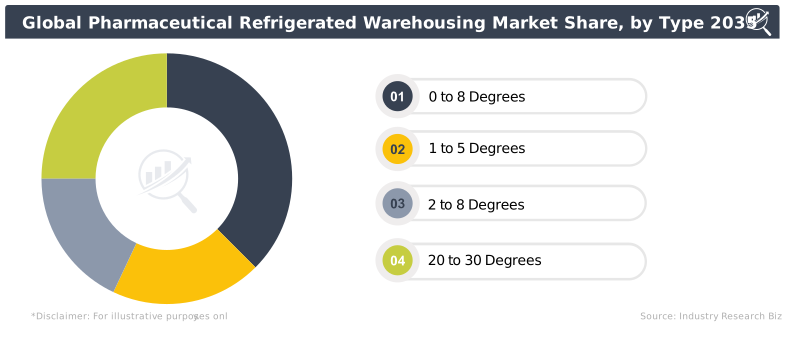
0 to 8 Degrees: The 0 to 8 Degrees segment accounts for approximately 28% of the Pharmaceutical Refrigerated Warehousing Market, supported by broad use across temperature-sensitive pharmaceutical inventories requiring controlled chilled conditions throughout storage and handling. This range provides flexibility for facilities managing mixed pharmaceutical portfolios where products have different but overlapping refrigeration requirements. Warehouse operators serving this segment increasingly use validated cold rooms, redundant refrigeration equipment, automated temperature alarms, and calibrated monitoring systems to maintain consistent environmental conditions. Multi-client pharmaceutical logistics facilities benefit from this range because it allows them to accommodate varied inventories without creating highly specialized infrastructure for every individual product.
1 to 5 Degrees: The 1 to 5 Degrees segment represents approximately 17% of market share and serves pharmaceutical products requiring a comparatively narrow refrigerated operating window. Maintaining tighter temperature tolerances requires precise airflow management, frequent calibration, high-quality monitoring equipment, and strong operating discipline. Facilities supporting this category increasingly use sensor networks positioned across storage racks and chambers to identify localized temperature variation before it becomes a product-quality issue. Narrower control bands can increase operating complexity because loading activity, door openings, equipment defrost cycles, and product placement can influence local conditions.
2 to 8 Degrees: The 2 to 8 Degrees segment leads the supplied Product Types with approximately 43% market share, reflecting its widespread use across vaccines, biologics, blood-related products, specialty medicines, and numerous temperature-sensitive pharmaceutical formulations. This range is one of the most established cold-chain standards across pharmaceutical manufacturing and distribution, resulting in extensive investment in qualified storage rooms, refrigerated docks, controlled staging areas, and validated transport interfaces. Warehouse operators increasingly combine automated inventory tracking with real-time temperature monitoring to improve traceability from inbound receipt through final dispatch.
-20 to -30 Degrees: The -20 to -30 Degrees segment contributes approximately 12% of the Pharmaceutical Refrigerated Warehousing Market and is becoming increasingly important for specialized biological materials, selected vaccines, research products, and pharmaceutical inventories requiring frozen storage. Facilities operating within this range require higher refrigeration intensity, stronger insulation, specialized doors, reliable backup systems, and additional safety procedures because temperature recovery can be slower after equipment disruption. Operators are investing in redundant freezer systems and remote monitoring to reduce the risk of excursions. Although the segment represents a smaller portion of total capacity, increasing development of advanced biological products and more complex pharmaceutical supply chains is creating demand for facilities capable of supporting frozen and conventional refrigerated products within the same validated logistics network.
By Applications
Blood and Blood Products: Blood and Blood Products account for approximately 32% of Pharmaceutical Refrigerated Warehousing demand because plasma-derived materials, blood components, diagnostic products, and associated healthcare inventories require carefully controlled storage and documented handling. Warehouses supporting these products must maintain high levels of traceability because individual lots and units can have strict shelf-life and temperature requirements. Continuous monitoring, secure access, controlled picking, and rapid exception management are essential operating functions. Healthcare systems and specialized distributors increasingly rely on regional refrigerated hubs to maintain product availability near hospitals and treatment centers.
Vaccine: Vaccine applications lead the market with approximately 46% share, supported by routine immunization programs, seasonal vaccination, travel medicine, pandemic preparedness, and increasing vaccine manufacturing across multiple regions. Vaccines generally require uninterrupted temperature control from production through healthcare delivery, making refrigerated warehousing a critical link within distribution networks. Operators serving this application invest heavily in validated chambers, backup generators, alarm escalation systems, controlled loading areas, and rapid-response procedures. National and regional vaccination programs also create fluctuating inventory requirements, requiring facilities to scale storage capacity during periods of elevated demand.
Others: Other applications represent approximately 22% of market demand and include temperature-sensitive biologics, specialty medicines, clinical-trial materials, diagnostic products, and other pharmaceutical inventories requiring refrigerated or frozen conditions. This category is expanding as pharmaceutical pipelines become more biologically complex and as personalized therapies increase the need for specialized handling. Warehousing providers serving these products often manage smaller lots with higher individual product value, increasing the importance of security, traceability, and controlled access. Clinical-trial logistics also requires flexible inventory management because products may need to be distributed to multiple research centers according to enrollment schedules.
Pharmaceutical Refrigerated Warehousing Market Regional Outlook
Get Comprehensive Insights into the Market’s Size and Growth Trends
Download FREE Sample North America
North America leads the Pharmaceutical Refrigerated Warehousing Market with approximately 35% share, supported by extensive pharmaceutical production, large biologics pipelines, established vaccine programs, sophisticated healthcare distribution, and high demand for specialty medicines. The United States contributes the majority of regional activity, while Canada maintains a developed pharmaceutical cold-chain network serving hospitals, wholesalers, research organizations, and healthcare providers. Warehouse operators are expanding validated capacity near major pharmaceutical manufacturing clusters and transportation corridors to reduce delivery times and provide stronger supply-chain resilience.
Regional providers are increasingly investing in automation and digital monitoring to improve operating reliability across large refrigerated networks. Approximately 38% of facility modernization programs emphasize continuous temperature visibility, automated inventory handling, predictive refrigeration maintenance, or advanced warehouse-management integration. Demand for pharmaceutical logistics is also being influenced by growth in clinical research and biologic therapies requiring smaller, higher-value shipments. These conditions encourage warehouse operators to combine storage with packaging, order preparation, transportation coordination, and quality-management services to create more integrated pharmaceutical logistics solutions.
Europe
Europe accounts for approximately 27% of global market demand, supported by major pharmaceutical manufacturing centers, established healthcare systems, vaccine production, biotechnology development, and extensive cross-border distribution. Germany, France, the United Kingdom, Switzerland, Italy, Belgium, and the Netherlands remain important logistics markets because of their pharmaceutical manufacturing activity and access to major road, air, and seaport infrastructure. Refrigerated warehouses increasingly serve multiple countries from strategically located distribution hubs, making standardized quality systems and temperature documentation especially important for cross-border pharmaceutical movements.
Energy efficiency is becoming a major investment priority across European refrigerated facilities because refrigeration systems represent a large portion of warehouse electricity demand. Approximately 30% of modernization initiatives are focused on improved insulation, efficient compressors, intelligent refrigeration controls, heat recovery, or renewable-energy integration. Sustainability expectations are encouraging operators to reduce power consumption without weakening temperature stability.
Asia-Pacific
Asia-Pacific represents approximately 25% of the Pharmaceutical Refrigerated Warehousing Market and is one of the fastest-developing regional opportunities because pharmaceutical manufacturing, vaccine production, healthcare expenditure, clinical research, and domestic medicine consumption continue expanding. China, India, Japan, South Korea, Singapore, and Australia support significant cold-chain demand, while Southeast Asian markets are gradually improving pharmaceutical distribution infrastructure. Rising exports of vaccines, biologics, and specialty medicines are increasing the requirement for warehouses capable of meeting international temperature-control and documentation standards.
Infrastructure expansion is particularly important across developing Asian pharmaceutical hubs where existing cold-storage capacity may not fully match growing manufacturing output. Approximately 36% of regional investment activity is directed toward new refrigerated facilities, multi-temperature chambers, airport-adjacent logistics hubs, and digitally monitored distribution centers. High ambient temperatures across many parts of the region increase cooling requirements and make reliable backup systems essential.
Middle East and Africa
Middle East and Africa account for approximately 7% of global market demand, with refrigerated pharmaceutical warehousing expanding around healthcare investment, vaccine distribution, population growth, and increasing pharmaceutical imports. Gulf countries are developing modern logistics hubs near airports and major cities, while African markets continue strengthening healthcare supply chains for vaccines, blood products, and essential temperature-sensitive medicines. Reliable storage is particularly important in areas where high outdoor temperatures increase the risk associated with power interruptions or extended transportation times.
Public-health programs and regional distribution initiatives are encouraging investment in stronger refrigerated infrastructure. Approximately 22% of emerging capacity development is associated with vaccine distribution, healthcare logistics, and efforts to improve temperature-controlled access outside major metropolitan areas. Operators must address electricity reliability, backup generation, equipment maintenance, and staff training while keeping services affordable.
Rest of the World
Rest of the World represents approximately 6% of the Pharmaceutical Refrigerated Warehousing Market, including smaller Latin American, island, and developing pharmaceutical distribution markets. Demand is supported by growing healthcare access, vaccine imports, specialty medicines, and expansion of organized pharmaceutical distribution. Warehouses in these markets increasingly serve as consolidation points where imported temperature-sensitive products are received, inspected, stored, and redistributed to hospitals, clinics, pharmacies, and regional healthcare networks.
Infrastructure modernization is gradually improving cold-chain reliability across these markets, with approximately 19% of new logistics investment focused on refrigerated capacity, backup power, digital temperature monitoring, or improved distribution connectivity. International pharmaceutical companies increasingly expect local logistics partners to maintain documented storage conditions comparable with larger developed markets. This creates opportunities for operators capable of upgrading quality systems and integrating storage with validated transportation, customs coordination, and final-mile healthcare distribution.
List of Top Pharmaceutical Refrigerated Warehousing Market Companies
- Americold
- Lineage Logistics
- United States Cold Storage
- DHL
- Nichirei Logistics Group
- Burris Logistics
- VersaCold Logistics Services
- Congebec
- Conestoga Cold Storage
- Kloosterboer
- Hanson Logistics
- NewCold Advanced Cold Logistics
- Trenton Cold Storage
Top Two Companies with Highest Market Share
- DHL: DHL is estimated to account for approximately 17% of activity within the supplied competitive landscape, supported by its extensive healthcare logistics network, temperature-controlled warehousing capabilities, validated transport services, and global distribution reach.
- Lineage Logistics: Lineage Logistics is estimated to represent approximately 14% of the supplied competitive landscape, supported by its large refrigerated warehousing footprint, technology-led facility operations, and experience managing temperature-sensitive products across extensive distribution networks. Its scale provides capabilities in automated storage, energy-efficient refrigeration, inventory management, and multi-location logistics services. Expansion into more specialized temperature-controlled applications creates opportunities to support pharmaceutical and healthcare customers requiring dependable cold-chain infrastructure.
Investment Analysis and Opportunities
Investment in the Pharmaceutical Refrigerated Warehousing Market is increasingly focused on validated multi-temperature facilities, automation, monitoring technologies, energy-efficient refrigeration, and geographically diversified distribution networks. Approximately 34% of strategic investment activity is directed toward infrastructure capable of supporting biologics, vaccines, specialty medicines, and other high-value products requiring more sophisticated environmental control than conventional pharmaceutical inventories. Developers are prioritizing locations close to manufacturing clusters, airports, healthcare centers, and major transport corridors to reduce transit exposure and improve response times.
Emerging pharmaceutical manufacturing regions create additional opportunities for warehouse operators seeking long-term expansion. Approximately 28% of future investment potential is associated with markets where vaccine production, biologics manufacturing, pharmaceutical exports, healthcare spending, and clinical research are increasing faster than specialized cold-chain capacity. Multi-client refrigerated facilities can help manufacturers avoid building dedicated warehouses while obtaining access to validated infrastructure and trained logistics teams. Investment opportunities also extend to modular cold rooms, lower-temperature chambers, automated retrieval systems, solar-supported backup power, and remote monitoring.
New Product Development
New product development within pharmaceutical refrigerated warehousing is increasingly centered on intelligent monitoring platforms, automated storage systems, energy-efficient refrigeration equipment, and digitally connected facility-management tools. Approximately 31% of recent infrastructure development activity emphasizes improved temperature assurance, digital traceability, automated inventory handling, or energy-performance optimization. Warehouse operators are installing denser sensor networks capable of monitoring individual zones continuously while linking environmental data with product-location information. Automated alerts enable quality teams to respond quickly to abnormal conditions, while predictive maintenance can identify refrigeration problems before they result in major temperature deviations.
Energy-efficient refrigeration and resilient backup systems represent another important area of development as operators seek to reduce operating costs without compromising compliance. Approximately 24% of new facility-design initiatives are concentrating on high-efficiency compressors, improved insulation, intelligent refrigeration controls, heat recovery, renewable-energy integration, or advanced backup-power architectures. Modern facilities are increasingly designed with independent refrigeration zones so an equipment issue in one area does not affect the entire warehouse. This modular approach can also simplify maintenance and allow operators to support different pharmaceutical temperature requirements within one site.
Five Recent Developments
- January 2026 – Automated Cold Storage Capacity Expands: Pharmaceutical logistics operators increased investment in automated storage and retrieval systems, with approximately 31% of new infrastructure initiatives emphasizing faster inventory handling, improved temperature stability, reduced manual movement, and stronger digital traceability.
- March 2026 – Real-Time Temperature Monitoring Gains Adoption: Warehouse providers expanded connected sensor networks and automated alarm systems, with approximately 27% of technology upgrades focusing on continuous environmental visibility, faster excursion detection, and improved compliance documentation across refrigerated pharmaceutical facilities.
- May 2026 – Multi-Temperature Facilities Support Biologics Growth: Logistics companies increased development of warehouses capable of supporting several controlled temperature zones, with approximately 25% of facility expansion programs designed to accommodate vaccines, biologics, specialty medicines, and frozen pharmaceutical products.
- July 2026 – Energy Efficient Refrigeration Modernization Accelerates: Cold-chain operators upgraded refrigeration equipment and building insulation, with approximately 23% of modernization activity targeting lower electricity consumption, improved thermal stability, reduced equipment stress, and more sustainable pharmaceutical warehouse operations.
- September 2026 – Regional Pharmaceutical Distribution Hubs Expand: Logistics providers strengthened regional cold-chain networks near manufacturing and healthcare clusters, with approximately 29% of capacity-development activity focused on shortening delivery routes, improving inventory availability, and reducing temperature-excursion exposure during transportation.
Report Coverage
The Pharmaceutical Refrigerated Warehousing Market report evaluates storage requirements across the supplied Product Types of 0 to 8 Degrees, 1 to 5 Degrees, 2 to 8 Degrees, and -20 to -30 Degrees, together with Blood and Blood Products, Vaccine, and Others applications. The 2 to 8 Degrees category represents approximately 43% of the supplied Product Type allocation, reflecting its widespread use across vaccines, biologics, specialty pharmaceuticals, and other temperature-sensitive products. The coverage examines refrigeration technologies, warehouse validation, temperature monitoring, automation, backup power, energy efficiency, inventory traceability, loading procedures, facility qualification, risk management, and regulatory compliance.
The regional analysis covers North America, Europe, Asia-Pacific, Middle East and Africa, and Rest of the World, with North America accounting for approximately 35% of the regional market allocation. Competitive coverage includes Americold, Lineage Logistics, United States Cold Storage, DHL, Nichirei Logistics Group, Burris Logistics, VersaCold Logistics Services, Congebec, Conestoga Cold Storage, Kloosterboer, Hanson Logistics, NewCold Advanced Cold Logistics, and Trenton Cold Storage.
Pharmaceutical Refrigerated Warehousing Market Report Coverage
| REPORT COVERAGE | DETAILS | |
|---|---|---|
|
Market Size Value In |
USD 3842.28 Million in 2026 |
|
|
Market Size Value By |
USD 8826.1 Million by 2035 |
|
|
Growth Rate |
CAGR of 9.68% from 2026-2035 |
|
|
Forecast Period |
2026 - 2035 |
|
|
Base Year |
2025 |
|
|
Historical Data Available |
Yes |
|
|
Regional Scope |
Global |
|
|
Segments Covered |
By Type :
By Application :
|
|
|
To Understand the Detailed Market Report Scope & Segmentation
Download FREE Sample
|
||
Frequently Asked Questions
The global Pharmaceutical Refrigerated Warehousing Market is expected to reach USD 8826.1 Million by 2035.
The Pharmaceutical Refrigerated Warehousing Market is expected to exhibit a CAGR of 9.68% by 2035.
Americold, Lineage Logistics, United States Cold Storage, DHL, Nichirei Logistics Group, Burris Logistics, VersaCold Logistics Services, Congebec, Conestoga Cold Storage, Kloosterboer, Hanson Logistics, NewCold Advanced Cold Logistics, Trenton Cold Storage
In 2026, the Pharmaceutical Refrigerated Warehousing Market value will reach at USD 3842.28 Million.

Related Reports

Our Clients






























.svg)
