

Operational Technology Security Market Size, Share, Growth, and Industry Analysis, By Type (Consulting, Managed Security Services), By Application (Hardware, Software), Regional Insights and Forecast to 2035
 Buy Now


Operational Technology Security Market Overview
The global Operational Technology Security Market is set to grow from USD 27908.01 Million in 2026 to USD 109524.83 Million by 2035, exhibiting a CAGR of 16.41% over the forecast period 2026-2035.
The Operational Technology Security Market is expanding rapidly as manufacturing plants, energy systems, utilities, transportation networks, industrial facilities, and other critical environments connect previously isolated operational assets with enterprise networks, remote access platforms, cloud services, and Industrial Internet of Things infrastructure. Approximately 51% of current market growth momentum is associated with organizations seeking stronger visibility, segmentation, threat detection, vulnerability management, and incident-response capabilities across industrial control environments. Security teams are increasingly recognizing that conventional information-technology tools cannot always be deployed directly within operational networks because production availability, safety, deterministic communication, and legacy equipment create specialized requirements.
The United States remains one of the most important national markets because its manufacturing, energy, utilities, transportation, oil and gas, healthcare infrastructure, and other critical industries operate extensive connected industrial environments. Approximately 26% of worldwide Operational Technology Security activity is associated with United States organizations strengthening cyber resilience across production systems and critical infrastructure. Industrial operators increasingly need unified security programs capable of identifying unmanaged assets, monitoring network behavior, controlling remote access, and coordinating responses between IT and OT teams. Greater attention to ransomware, supply-chain exposure, remote maintenance connections, and critical-infrastructure resilience is increasing demand for Consulting and Managed Security Services.
Get Comprehensive Insights into the Market’s Size and Growth Trends
 Download FREE Sample
 Key Findings
- Market Driver: Increasing convergence between industrial operations and enterprise networks is accelerating OT cybersecurity investment, with approximately 51% of market momentum linked to asset visibility, network protection, secure remote access, segmentation, and threat monitoring.
- Major Market Restraint: Legacy industrial equipment and limited cybersecurity resources continue slowing modernization, with approximately 22% of deployment pressure associated with unsupported systems, operational downtime concerns, integration complexity, specialist shortages, and fragmented security ownership.
- Emerging Trends: AI-assisted monitoring, passive asset discovery, zero-trust access, and industrial threat intelligence are reshaping security architecture, with approximately 37% of technology development increasingly focused on earlier anomaly identification and automated risk prioritization.
- Regional Leadership: North America is expected to lead the Operational Technology Security Market with approximately 35% share, supported by extensive critical infrastructure, industrial digitization, cybersecurity investment, regulatory attention, and advanced security-service adoption.
- Competitive Landscape: OT cybersecurity providers are expanding integrated monitoring, threat intelligence, managed detection, and consulting portfolios, with Claroty estimated to represent approximately 18% of activity within the supplied competitive landscape across industrial security environments.
- Market Segmentation: Managed Security Services are expected to lead the supplied Product Types with approximately 58% market share, while Software remains the dominant Application as industrial organizations expand continuous monitoring and centralized cybersecurity management.
- Recent Development: Security providers are increasing AI-enabled industrial monitoring and automated asset-risk capabilities, with approximately 33% of recent product-development activity emphasizing anomaly detection, exposure prioritization, threat intelligence, or unified OT security operations.
Latest Trends
Artificial intelligence and behavior-based monitoring are becoming important trends as industrial organizations attempt to detect subtle changes in operational network activity before they develop into disruptive incidents. Approximately 37% of current technology-development activity is increasingly focused on AI-assisted anomaly detection, automated asset classification, behavioral baselining, threat prioritization, and industrial network analytics. OT security platforms are moving beyond simple device inventories toward contextual understanding of asset function, communication patterns, vulnerabilities, and operational importance. Passive monitoring remains particularly valuable because many industrial systems cannot tolerate aggressive scanning.
Managed security is also becoming more important as industrial organizations struggle to maintain specialized cybersecurity expertise around the clock. Approximately 29% of security-program modernization is associated with outsourced monitoring, managed detection, threat hunting, incident-response support, and remote security operations designed specifically for industrial environments. Traditional security operations centers often lack visibility into industrial protocols and production priorities, creating demand for specialists who understand both cybersecurity and operational processes. Managed service providers increasingly combine centralized monitoring with industrial threat intelligence and on-site response planning.
Market Dynamics
Driver
"IT and OT convergence is accelerating industrial cybersecurity investment."
Increasing connectivity between operational systems and enterprise technology represents the strongest structural driver for the Operational Technology Security Market. Approximately 51% of current market momentum is associated with industrial organizations expanding asset visibility, network segmentation, remote-access protection, vulnerability management, and continuous monitoring. Manufacturing plants and infrastructure operators increasingly connect production assets with analytics platforms, enterprise software, cloud environments, and remote maintenance tools to improve efficiency and operational visibility. These connections also create additional pathways through which cyber threats can reach industrial systems. Security programs therefore need to protect both conventional IT infrastructure and specialized operational assets without interrupting production or safety processes.The expansion of remote access is reinforcing this driver because industrial equipment increasingly requires support from engineers, equipment vendors, contractors, and maintenance specialists who may not be physically present at the site.
Restraint
"Legacy infrastructure complicates secure industrial modernization."
Legacy industrial equipment remains a major restraint because many operational environments contain systems designed years before modern cybersecurity requirements became important. Approximately 22% of deployment pressure is associated with unsupported operating systems, proprietary industrial protocols, limited processing capacity, difficult patching processes, and concerns that security modifications could interrupt production. Industrial operators may keep equipment in service for decades because replacing machinery can require major capital investment and plant downtime. Security teams must therefore develop compensating controls such as network segmentation, monitoring, restricted access, and virtual patching rather than relying entirely on conventional endpoint protection.Specialist shortages create an additional restraint because OT cybersecurity requires knowledge of industrial engineering, safety, network architecture, operational processes, and cyber risk simultaneously.
Opportunity
"Managed security creates scalable protection for industrial environments."
Managed Security Services create a major market opportunity because industrial operators increasingly require continuous cybersecurity monitoring without maintaining large specialized teams at every facility. Approximately 34% of emerging commercial opportunity is associated with managed detection, industrial threat intelligence, vulnerability prioritization, incident-response retainers, and centralized security operations. Providers can monitor multiple manufacturing sites, utility assets, transportation systems, or remote industrial facilities through coordinated platforms while escalating suspicious activity to customer teams. This operating model can improve coverage for organizations that previously relied on periodic security assessments rather than continuous monitoring.Critical-infrastructure modernization across developing economies provides another opportunity as industrial digitization increases connectivity across energy, manufacturing, transportation, utilities, and other essential services.
Challenge
"Protecting operations without disrupting production remains difficult."
Maintaining operational availability while deploying stronger cybersecurity controls remains one of the market's most important challenges. Approximately 31% of OT security implementation complexity is associated with avoiding production interruption while introducing monitoring, segmentation, authentication, software updates, or incident-response procedures. Industrial facilities may operate continuously, leaving limited maintenance windows for system changes. A cybersecurity control that affects communication timing or equipment behavior can create operational consequences far beyond ordinary IT inconvenience. Security architectures must therefore be tested carefully and adapted to the operating characteristics of individual plants, machines, and control systems.Fragmented asset visibility creates another major challenge because organizations often operate equipment from multiple generations and vendors across numerous facilities.
Operational Technology Security Market Segmentation
Get Comprehensive Insights on the Market Segmentation in this Report
Download FREE Sample
Get Comprehensive Insights on the Market Segmentation in this Report
Download FREE Sample By Types
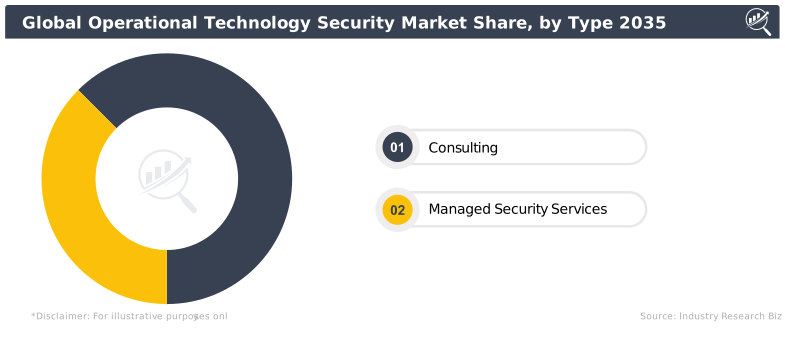
Consulting: Consulting accounts for approximately 42% of the Operational Technology Security Market, supported by demand for asset discovery, architecture assessment, risk analysis, compliance planning, incident-response preparation, network segmentation design, and OT security governance. Industrial organizations frequently begin cybersecurity modernization with consulting engagements because existing plants contain mixed generations of controllers, engineering workstations, network equipment, remote-access systems, and proprietary operational technologies. Consultants help organizations identify critical assets, map communication pathways, evaluate cyber exposure, and establish prioritized improvement roadmaps without disrupting production. Demand is particularly strong among manufacturers, utilities, transportation operators, and industrial companies that lack mature internal OT security teams.
Managed Security Services: Managed Security Services lead the supplied Product Types with approximately 58% market share as organizations seek continuous monitoring, threat detection, vulnerability prioritization, managed incident response, and access to specialized industrial cybersecurity expertise. Large industrial operators may oversee dozens of plants and thousands of devices, making centralized security operations more efficient than maintaining separate monitoring teams at every facility. Managed providers can collect network telemetry, evaluate suspicious behavior, correlate threat intelligence, and escalate high-priority events while internal engineering personnel remain focused on production. This model is increasingly attractive for organizations facing persistent staffing shortages and growing requirements for continuous OT visibility.
By Applications
Hardware: Hardware applications represent approximately 37% of the Operational Technology Security Market, supported by industrial firewalls, secure gateways, network appliances, sensors, segmentation devices, ruggedized security equipment, and other physical technologies deployed across plant environments. Hardware remains important where organizations require dedicated controls between production zones, enterprise networks, remote sites, and third-party connections. Industrial security appliances are often engineered for high availability, harsh environmental conditions, and support for specialized communication protocols. Utilities, manufacturing facilities, transportation infrastructure, and geographically dispersed industrial operations use hardware-based security to establish controlled network boundaries while protecting older devices that cannot host modern endpoint-security software.
Software: Software leads the supplied Applications with approximately 63% market share as industrial organizations increase investment in continuous asset discovery, anomaly detection, vulnerability management, threat intelligence, network monitoring, identity controls, and centralized security operations. Software platforms can provide visibility across diverse operational environments without requiring security agents on every industrial device. Passive monitoring systems analyze communication patterns and industrial protocols to identify assets, dependencies, abnormal activity, and security exposures. Centralized dashboards also help IT and OT teams prioritize vulnerabilities according to operational importance rather than relying only on generic severity scores.
Operational Technology Security Market Regional Outlook
Get Comprehensive Insights into the Market’s Size and Growth Trends
Download FREE Sample North America
North America leads the Operational Technology Security Market with approximately 35% market share, supported by extensive critical infrastructure, advanced manufacturing, large energy and utility networks, industrial digitization, and strong cybersecurity investment. The United States contributes the majority of regional demand as operators modernize protection across manufacturing plants, electricity infrastructure, transportation systems, pipelines, and other essential services. Organizations increasingly deploy passive asset discovery, industrial network monitoring, secure remote access, segmentation, and managed security services to improve resilience against ransomware, supply-chain threats, and targeted attacks.
Regional modernization is increasingly centered on continuous security operations, with approximately 41% of major OT cybersecurity programs emphasizing centralized monitoring, vulnerability prioritization, threat intelligence, or managed detection. Organizations are also strengthening collaboration between IT security teams and operational engineering groups to improve incident response. Greater regulatory attention to critical infrastructure is encouraging asset owners to formalize cyber-risk programs while creating demand for Consulting and Managed Security Services that understand specialized industrial environments.
Europe
Europe represents approximately 25% of global market demand, supported by advanced manufacturing, energy infrastructure, transportation systems, industrial automation, and increasing cybersecurity requirements across critical sectors. Germany, the United Kingdom, France, Italy, the Netherlands, and Nordic countries remain important adoption markets. Industrial companies are expanding OT asset inventories, segmentation, secure access, and monitoring as factories connect more operational systems to enterprise data platforms. Energy-transition infrastructure also creates new security requirements across renewable generation, distributed assets, and increasingly digital utility networks.
Regulatory compliance is becoming a stronger purchasing influence, with approximately 32% of European OT security programs increasingly linked to governance, resilience requirements, supply-chain controls, or formal cyber-risk management. Organizations are moving beyond periodic assessments toward continuous monitoring and documented security operations. Managed providers are benefiting as manufacturers and infrastructure operators seek specialist expertise without maintaining large internal industrial-security teams across every facility.
Asia-Pacific
Asia-Pacific accounts for approximately 28% of the Operational Technology Security Market, supported by large manufacturing ecosystems, energy infrastructure, transportation investment, industrial automation, and rapid adoption of connected production technologies. China, Japan, South Korea, India, Australia, and Southeast Asian economies represent important regional markets. Expanding smart factories and digitally managed utilities are increasing the number of connected operational assets that require stronger cyber visibility and access controls.
Industrial digitalization is creating substantial security demand, with approximately 38% of regional modernization initiatives emphasizing connected manufacturing, remote operations, industrial IoT, or centralized operational monitoring. Organizations increasingly recognize that production efficiency programs must include cybersecurity controls from the design stage. Demand is therefore expanding for Consulting services that assess industrial architectures and Managed Security Services capable of monitoring multiple facilities while adapting to varying levels of security maturity.
Middle East and Africa
Middle East and Africa account for approximately 7% of the global market, supported by oil and gas operations, utilities, mining, transportation infrastructure, industrial projects, and expanding smart-city programs. Gulf countries are particularly active in strengthening cybersecurity across energy and infrastructure environments where operational disruption could create substantial economic consequences. African demand is developing around utilities, mining operations, manufacturing, and other industrial sectors modernizing previously isolated operational systems.
Critical infrastructure protection represents a major regional priority, with approximately 24% of emerging security initiatives centered on energy systems, industrial plants, transport networks, or utility operations requiring continuous availability. Managed Security Services can provide particular value where local OT cybersecurity skills remain limited. Remote monitoring, secure third-party access, and centralized threat detection are increasingly important for operators managing geographically dispersed facilities or assets in difficult-to-reach locations.
Rest of the World
Rest of the World represents approximately 5% of the Operational Technology Security Market, reflecting demand across smaller Latin American, island, and developing industrial economies. Adoption is supported by modernization of manufacturing, utilities, energy infrastructure, transportation systems, and mining operations. Many organizations are beginning OT security programs with asset discovery and architecture assessments before progressing toward advanced monitoring and managed detection.
Phased cybersecurity adoption is common across these markets, with approximately 18% of new initiatives emphasizing foundational visibility, remote-access controls, network segmentation, and basic incident-response planning. Consulting services remain important because organizations often need assistance identifying critical assets before selecting technology. As industrial connectivity expands, demand is expected to move gradually toward continuous software monitoring and managed services capable of supporting long-term operational resilience.
List of Top Operational Technology Security Market Companies
- Bayshore
- Indegy
- Honeywell-Nextnine
- Darktrace
- Deloitte
- Kaspersky Lab
- Leidos
- IOActive
- Cisco
- CyberX
- Dragos
- Cyberbit
- Icon Labs
- Belden
- NCC Group
- Accenture
- GE (Wurldtech)
- Claroty
Top Two Companies with Highest Market Share
- Claroty: Claroty is estimated to represent approximately 18% of activity within the supplied competitive landscape, supported by its focus on industrial asset visibility, exposure management, network monitoring, secure access, and operational technology threat detection.
- Dragos: Dragos is estimated to account for approximately 15% of activity across the supplied competitive landscape, supported by specialized industrial threat intelligence, managed detection, incident-response capabilities, and OT-focused security technology.
Investment Analysis and Opportunities
Investment in the Operational Technology Security Market is increasingly directed toward managed detection, asset visibility, secure remote access, industrial vulnerability management, and integrated IT-OT security operations. Approximately 36% of strategic investment activity is associated with platforms capable of continuously identifying assets, mapping communication relationships, detecting unusual behavior, and prioritizing risks according to operational importance. Manufacturers and infrastructure operators are moving away from isolated security projects toward multi-year programs covering multiple plants, remote sites, and business units.
Critical infrastructure modernization creates an additional investment opportunity as organizations connect older operational systems with cloud platforms, analytics, remote maintenance tools, and enterprise networks. Approximately 30% of future market opportunity is linked to phased cybersecurity programs that begin with Consulting and progress toward continuous Managed Security Services. Industrial companies increasingly need external expertise to assess legacy architecture, design segmentation strategies, establish incident-response procedures, and operate monitoring platforms across distributed facilities.
New Product Development
New product development is increasingly centered on AI-enabled industrial monitoring, automated asset classification, behavioral analytics, and exposure prioritization. Approximately 33% of recent product-development activity emphasizes anomaly detection, threat intelligence, attack-path analysis, or unified OT security operations. Claroty, Dragos, Darktrace, Cisco, Honeywell-Nextnine, Cyberbit, Belden, and other suppliers are strengthening platforms that can analyze industrial communication without actively scanning sensitive control systems. Modern software increasingly combines asset inventory, vulnerability context, device criticality, and network behavior in one interface, allowing security teams to distinguish urgent operational risks from lower-priority technical findings.
Secure remote-access technology is another major development area as industrial organizations seek tighter control over vendor, contractor, and engineering connections. Approximately 27% of next-generation OT security functionality is associated with identity verification, session monitoring, privileged access, device validation, and policy-based connectivity. New platforms increasingly allow organizations to grant temporary access only to approved assets while maintaining detailed records of user activity.
Five Recent Developments
- January 2026 – AI Monitoring Expands Across Industrial Networks: OT security providers increased deployment of behavior-based analytics, with approximately 33% of recent development activity focusing on anomaly detection, automated asset intelligence, and faster identification of suspicious industrial network behavior.
- March 2026 – Managed Detection Services Gain Industrial Adoption: Manufacturers and infrastructure operators expanded outsourced security monitoring, with approximately 29% of service-development activity emphasizing continuous threat detection, industrial incident support, and centralized oversight across multiple operational facilities.
- May 2026 – Secure Remote Access Controls Become Stronger: Security vendors enhanced third-party connectivity platforms, with approximately 26% of access-control initiatives concentrating on identity verification, session monitoring, temporary permissions, and reduced reliance on permanently enabled industrial remote connections.
- July 2026 – Asset Exposure Platforms Improve Risk Prioritization: OT security platforms expanded contextual vulnerability management, with approximately 31% of product enhancements focusing on asset criticality, attack-path visibility, exposure scoring, and prioritization of weaknesses that could affect operational continuity.
- September 2026 – Unified IT OT Security Platforms Expand: Industrial cybersecurity providers strengthened integration between enterprise and operational security operations, with approximately 28% of modernization initiatives emphasizing shared dashboards, coordinated incident workflows, and centralized threat visibility across connected environments.
Report Coverage
The Operational Technology Security Market report evaluates the supplied Product Types of Consulting and Managed Security Services together with Hardware and Software applications. Managed Security Services represent approximately 58% of the Product Type allocation, reflecting increasing demand for continuous monitoring, threat detection, vulnerability prioritization, industrial incident response, and access to specialized OT cybersecurity expertise. The coverage examines passive asset discovery, industrial network monitoring, secure remote access, segmentation, cybersecurity consulting, managed detection, threat intelligence, vulnerability management, artificial intelligence, incident-response planning, cybersecurity workforce requirements, and protection of legacy industrial environments.
The regional assessment covers North America, Europe, Asia-Pacific, Middle East and Africa, and Rest of the World, with North America representing approximately 35% of the regional market allocation. Competitive coverage includes Bayshore, Indegy, Honeywell-Nextnine, Darktrace, Deloitte, Kaspersky Lab, Leidos, IOActive, Cisco, CyberX, Dragos, Cyberbit, Icon Labs, Belden, NCC Group, Accenture, GE (Wurldtech), and Claroty. The report further evaluates investment opportunities, industrial digitization, critical-infrastructure protection, cybersecurity regulation, managed services, software innovation, secure remote access, and the evolving requirement to protect connected operational systems without disrupting production, safety, or availability.
Operational Technology Security Market Report Coverage
| REPORT COVERAGE | DETAILS | |
|---|---|---|
|
Market Size Value In |
USD 27908.01 Million in 2026 |
|
|
Market Size Value By |
USD 109524.83 Million by 2035 |
|
|
Growth Rate |
CAGR of 16.41% from 2026-2035 |
|
|
Forecast Period |
2026 - 2035 |
|
|
Base Year |
2025 |
|
|
Historical Data Available |
Yes |
|
|
Regional Scope |
Global |
|
|
Segments Covered |
By Type :
By Application :
|
|
|
To Understand the Detailed Market Report Scope & Segmentation
Download FREE Sample
|
||
Frequently Asked Questions
The global Operational Technology Security Market is expected to reach USD 109524.83 Million by 2035.
The Operational Technology Security Market is expected to exhibit a CAGR of 16.41% by 2035.
Bayshore, Indegy, Honeywell-Nextnine, Darktrace, Deloitte, Kaspersky Lab, Leidos, IOActive, Cisco, CyberX, Dragos, Cyberbit, Icon Labs, Belden, NCC Group, Accenture, GE (Wurldtech), Claroty
In 2026, the Operational Technology Security Market value will reach at USD 27908.01 Million.

Related Reports

Our Clients






























.svg)
