

Multi-functional Printer Market Size, Share, Growth, and Industry Analysis, By Type (Color Multi-Function Printer, Monochrome Multi-Function Printer), By Application (Commercial Office, Residential Application, Others), Regional Insights and Forecast to 2035
 Buy Now


Multi-functional Printer Market Overview
The global Multi-functional Printer Market is projected to expand steadily from USD 24313.81 Million in 2026 to USD 39270.26 Million by 2035, representing a CAGR of 5.47% during 2026-2035.
The Multi-functional Printer Market continues to evolve as organizations consolidate printing, scanning, copying, document capture, workflow routing, and secure information management into integrated office devices. Color Multi-Function Printer products account for approximately 63% of overall demand as enterprises increasingly require professional-quality documents, marketing materials, presentations, training content, and visually rich business communication. Modern devices are moving beyond basic printing toward connected workplace platforms incorporating cloud access, mobile printing, automated document capture, user authentication, remote administration, fleet monitoring, and energy-management functions.
The United States remains a major national market because businesses, educational organizations, healthcare facilities, professional services firms, and public institutions maintain substantial installed bases of networked multifunction devices. Approximately 58% of enterprise replacement decisions increasingly emphasize security, cloud connectivity, automated scanning, remote device management, and lower operating complexity rather than printing speed alone. Managed print services are supporting fleet optimization as organizations seek to consolidate standalone devices, reduce maintenance requirements, automate consumable replenishment, and establish standardized security policies.
Get Comprehensive Insights into the Market’s Size and Growth Trends
 Download FREE Sample
 Key Findings
- Market Driver: Workplace digitization and integrated document management remain major demand drivers, with approximately 66% of enterprise procurement increasingly emphasizing combined printing, scanning, cloud connectivity, workflow automation, and secure document-processing capabilities.
- Major Market Restraint: Declining routine paper usage creates replacement pressure as approximately 27% of traditional office print activity is increasingly displaced by digital approvals, electronic records, collaboration platforms, and paperless administrative processes.
- Emerging Trends: Cloud-connected and intelligently managed devices are becoming increasingly important, with approximately 54% of advanced multifunction printer deployments emphasizing remote administration, automated workflow routing, mobile access, cybersecurity, or predictive maintenance capabilities.
- Regional Leadership: Asia-Pacific leads global demand with approximately 37% market share, supported by expanding offices, education infrastructure, public-sector modernization, manufacturing enterprises, small businesses, and continuing adoption of connected workplace equipment.
- Competitive Landscape: The supplied competitive landscape includes 14 companies increasingly competing through secure cloud platforms, managed print services, high-yield consumables, compact device portfolios, sustainability improvements, workflow software, and channel expansion.
- Market Segmentation: Color Multi-Function Printer leads the 2 supplied product categories with approximately 63% share, while Commercial Office remains the dominant application among the 3 supplied end-use categories because of centralized document-processing requirements.
- Recent Development: Manufacturers continue upgrading workplace devices, with approximately 42% of notable product initiatives emphasizing security enhancement, cloud integration, AI-assisted maintenance, faster scanning, energy efficiency, or automated document workflow capabilities.
Latest Trends
Smart multifunction printers are increasingly becoming digital workflow endpoints rather than independent imaging hardware. Approximately 54% of advanced deployments now prioritize connected capabilities such as cloud scanning, mobile printing, centralized administration, access control, encrypted communication, automated document routing, and fleet analytics. Enterprises increasingly expect printers to integrate with collaboration platforms, document repositories, identity-management systems, and business applications while allowing employees to print or scan securely from different workplace locations. Remote diagnostics and automated consumable monitoring are also gaining importance because distributed offices require IT teams to manage devices without constant on-site intervention.
Compact high-performance devices represent another important trend as hybrid working and decentralized office layouts change equipment deployment strategies. More than 4 workplace environments, including corporate branches, shared offices, home offices, retail locations, and customer-service points, increasingly require multifunction systems that occupy less space while retaining enterprise-level connectivity and security. Manufacturers are responding with smaller A4 devices, faster document feeders, touchscreen interfaces, duplex scanning, wireless connectivity, and cloud-ready software. Sustainability is also influencing purchasing decisions as organizations assess energy consumption, device longevity, recycled materials, cartridge yields, and fleet consolidation.
Market Dynamics
Driver
"Integrated document workflows are strengthening multifunction printer adoption."
Workplace digitalization remains a major market driver because organizations still require physical documents while simultaneously moving administrative processes toward digital systems. Approximately 66% of enterprise equipment procurement increasingly emphasizes devices capable of combining printing, scanning, copying, secure authentication, cloud connectivity, and automated document routing. Multifunction printers enable organizations to reduce the number of separate devices installed across workplaces while creating centralized points for transforming paper documents into digital information.
Managed print environments provide another growth foundation because more than 5 operational functions can be centralized through modern fleet-management platforms, including device monitoring, consumable tracking, user authentication, maintenance alerts, security configuration, and usage reporting. Enterprises increasingly seek predictable equipment performance while reducing administrative work associated with individual printers. Consolidating standalone machines into multifunction devices can simplify support requirements and improve visibility over printing behavior.
Restraint
"Digital documentation continues to reduce routine office printing volumes."
The expansion of electronic workflows remains the most important structural restraint because businesses increasingly replace printed documents with digital signatures, collaboration platforms, electronic invoices, cloud storage, and online forms. Approximately 27% of conventional office print activity faces displacement from paperless processes as employees share, review, approve, archive, and distribute information electronically. This reduces page volumes across mature corporate environments and can extend replacement cycles for existing devices. Manufacturers therefore face pressure to demonstrate value through scanning, workflow automation, cybersecurity, and document-management integration instead of relying solely on increasing printed output.
Device ownership also involves more than 4 recurring operating requirements, including consumables, maintenance, replacement parts, electricity, and IT administration. Smaller organizations may delay equipment upgrades when existing printers continue functioning adequately, particularly when overall paper usage is declining. Residential users can also substitute multifunction printers with digital document-sharing methods for many everyday tasks.
Opportunity
"Cloud-connected devices create opportunities beyond traditional office printing."
Cloud integration presents a substantial opportunity as multifunction printers become connected entry points for digital information. Approximately 49% of emerging deployment opportunities involve devices capable of scanning directly to cloud storage, workflow applications, collaboration platforms, email systems, or enterprise content repositories. These capabilities can reduce manual document handling while helping businesses connect physical records with digital processes. Vendors offering integrated software, secure user authentication, automated file naming, optical document processing, and customizable workflow shortcuts can strengthen differentiation across commercial environments where administrative efficiency is increasingly important.
Small businesses and distributed workplaces create further opportunities because more than 3 device characteristics—compact dimensions, wireless connectivity, and simplified administration—are increasingly important to decentralized teams. Employees working across branch offices, coworking spaces, smaller corporate locations, and residential environments still require occasional printing and frequent scanning capabilities. Manufacturers able to deliver compact multifunction products with enterprise-grade security, mobile access, economical consumables, and easy remote management can address these changing workplace structures without depending entirely on large centralized offices.
Challenge
"Cybersecurity requirements are increasing device-management complexity."
Network security represents a growing challenge because multifunction printers connect directly with enterprise systems and can process sensitive business information. More than 6 security controls may be required across advanced deployments, including user authentication, encrypted communication, firmware protection, secure startup, access management, data deletion, and network monitoring. Devices that remain operational for several years require regular security updates as new vulnerabilities and compliance requirements emerge. Manufacturers therefore need to support long-term firmware maintenance while enabling IT administrators to apply standardized protection across geographically distributed fleets.
Competition across hardware and service offerings creates another challenge because the supplied landscape includes 14 companies with established brands, channel networks, technology platforms, and differentiated product portfolios. Buyers increasingly compare not only print speed and image quality but also scanning performance, software integration, security, energy consumption, maintenance intervals, device footprint, and lifecycle support. Suppliers must continuously update both hardware and software capabilities while maintaining compatibility with evolving operating systems, mobile devices, cloud platforms, and enterprise security frameworks.
Multi-functional Printer Market Segmentation
Get Comprehensive Insights on the Market Segmentation in this Report
Download FREE Sample
Get Comprehensive Insights on the Market Segmentation in this Report
Download FREE Sample By Types
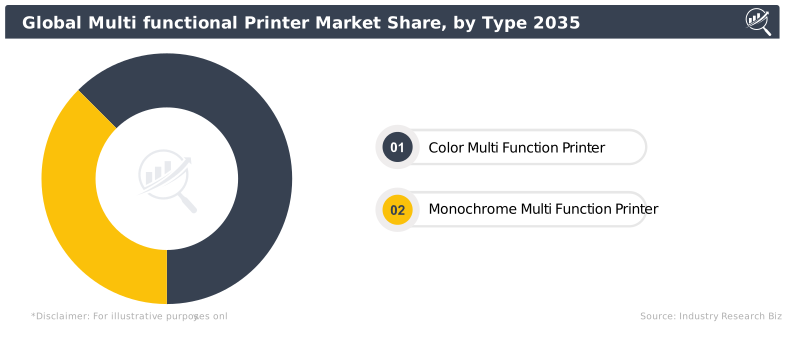
Color Multi-Function Printer: Color Multi-Function Printer accounts for approximately 63% of the Multi-functional Printer Market, making it the leading supplied product type. Demand is supported by commercial offices, educational institutions, professional services firms, healthcare organizations, retail businesses, and distributed workplaces requiring high-quality presentations, customer documents, promotional materials, charts, training resources, and administrative files. Modern color devices increasingly combine more than 6 capabilities, including printing, scanning, copying, duplex processing, mobile connectivity, cloud access, and document workflow integration, allowing organizations to consolidate multiple office functions within a single networked platform.
Color Multi-Function Printer adoption is also supported by improvements in toner efficiency, ink management, image processing, energy consumption, and automated color calibration. Enterprise users increasingly evaluate at least 5 operating factors, including print quality, page speed, scanning performance, cost per page, and cybersecurity before replacing existing devices. Compact color systems are gaining importance in decentralized offices, while larger departmental devices continue serving higher-volume commercial environments.
Monochrome Multi-Function Printer: Monochrome Multi-Function Printer represents approximately 37% of total market demand and remains important for organizations where text-heavy document production, operational reliability, rapid output, and economical high-volume printing are primary purchasing requirements. The category maintains significant demand across administrative offices, finance departments, logistics operations, educational institutions, healthcare facilities, government-related workplaces, and small businesses. Monochrome devices are frequently selected for more than 4 document categories, including invoices, internal records, shipping paperwork, reports, and standardized forms where color output provides limited additional operational value.
Demand for monochrome systems remains resilient because many high-volume workflows continue to prioritize speed and predictable operating costs. Advanced products increasingly offer at least 5 enterprise-level capabilities, including duplex scanning, encrypted printing, user authentication, wireless access, remote management, and automatic document feeding. Manufacturers are improving toner yields and energy efficiency while simplifying maintenance requirements to extend device usefulness across high-volume environments.
By Applications
Commercial Office: Commercial Office accounts for approximately 70% of Multi-functional Printer Market demand, making it the dominant supplied application. Corporate offices, small and medium enterprises, professional services firms, financial organizations, healthcare administrators, educational offices, retail headquarters, and other commercial environments continue to require integrated document systems. Modern office devices support more than 6 workflow functions involving document printing, scanning, copying, archiving, email distribution, cloud transfer, and secure document release.
Commercial customers increasingly purchase multifunction printers as part of managed workplace infrastructure rather than as isolated hardware. At least 5 purchasing priorities commonly influence enterprise decisions, including cybersecurity, fleet management, energy efficiency, scanning speed, and integration with existing software systems. Hybrid working has also encouraged companies to deploy smaller devices across branch locations while retaining higher-capacity systems in central offices.
Residential Application: Residential Application represents approximately 18% of overall market demand as remote working, home education, personal administration, creative activities, and small-business operations sustain household requirements for combined printing and scanning functionality. Home users increasingly prefer compact products that combine more than 4 core features, including printing, scanning, copying, wireless connectivity, and mobile-device access, without requiring separate office equipment. Space efficiency and simplified setup remain particularly important because residential devices are commonly installed in home offices, study areas, or shared living environments with limited dedicated workspace.
Residential purchasing decisions increasingly focus on at least 5 practical criteria: initial device cost, consumable yield, wireless reliability, compact dimensions, and ease of maintenance. Ink-efficient systems and automatic duplex printing are gaining attention among households that regularly produce school materials, forms, personal records, or small-business documents. Cloud scanning and smartphone printing further improve convenience by allowing users to manage physical and digital files without depending on a traditional desktop computer, strengthening multifunction printers as practical home productivity devices.
Others: Others account for approximately 12% of total Multi-functional Printer Market demand and include specialized environments outside the principal Commercial Office and Residential Application categories. These users can require multifunction devices for more than 4 operational purposes involving customer-facing documentation, transaction records, service forms, internal communication, and localized administrative processes. Requirements can vary significantly according to document volumes, physical space, network infrastructure, security needs, and user access patterns.
Demand within this application category is increasingly supported by compact network-ready devices that can operate across at least 3 workplace models involving shared facilities, decentralized locations, and specialized operational sites. Buyers generally prioritize reliable scanning, straightforward maintenance, mobile access, and manageable consumable requirements. Manufacturers capable of offering flexible configuration options and simplified deployment can address these fragmented requirements without relying exclusively on traditional corporate installations.
Regional Outlook
Get Comprehensive Insights into the Market’s Size and Growth Trends
Download FREE Sample North America
North America accounts for approximately 27% of global Multi-functional Printer Market demand, supported by extensive commercial office infrastructure, high adoption of managed print services, advanced cloud usage, hybrid working arrangements, and established enterprise IT ecosystems. Organizations increasingly deploy multifunction devices across more than 5 operational environments including corporate offices, healthcare facilities, educational institutions, professional services firms, and distributed branch locations. Security and remote administration have become important purchasing considerations as businesses integrate printing infrastructure with broader identity, networking, and document-management environments.
The United States contributes the majority of regional demand, while Canada maintains established adoption across commercial and institutional environments. Enterprise customers increasingly evaluate more than 6 capabilities covering encrypted printing, user authentication, cloud scanning, device analytics, mobile connectivity, fleet management, and sustainability. Replacement demand is shifting toward smarter systems capable of supporting hybrid workflows while reducing administrative complexity, helping manufacturers combine hardware sales with managed services and software-based workplace solutions.
Europe
Europe represents approximately 23% of worldwide Multi-functional Printer Market demand, supported by digital workplace modernization, mature commercial infrastructure, public and private organizational printing requirements, and increasing emphasis on energy-efficient equipment. Businesses across major European markets increasingly assess more than 4 lifecycle factors involving electricity consumption, consumable efficiency, device durability, and recycling practices when procuring workplace technology. Demand remains balanced between centralized enterprise systems and compact devices serving smaller offices and decentralized teams.
European customers are also placing greater emphasis on information security and document privacy as multifunction printers become integrated with cloud platforms and internal networks. Advanced deployments commonly incorporate at least 5 controls involving authentication, secure print release, encrypted transmission, access restrictions, and firmware management. Manufacturers are responding with cloud-enabled platforms, lower-energy equipment, recycled-material components, high-yield consumables, and fleet-monitoring tools designed to support sustainability and security requirements simultaneously.
Asia-Pacific
Asia-Pacific leads the global Multi-functional Printer Market with approximately 37% market share, supported by large commercial office populations, expanding small and medium businesses, education infrastructure, manufacturing organizations, government modernization, and increasing adoption of connected workplace equipment. Demand extends across more than 6 major economies and business centers where rapid enterprise digitalization continues alongside substantial physical documentation requirements. Color systems are gaining importance as businesses expand customer communication and digital-to-paper workflows, while monochrome devices remain widely used for high-volume administrative documentation.
Regional demand is further strengthened by expanding local manufacturing, channel networks, and competitively priced product portfolios. Organizations increasingly prioritize at least 5 features, including wireless connectivity, economical consumables, duplex scanning, remote administration, and mobile-device compatibility. Rapid growth of smaller offices and distributed business locations creates demand for compact multifunction products, while large corporations continue investing in managed fleets capable of integrating document processing with cloud-based workplace applications.
Middle East and Africa
Middle East and Africa accounts for approximately 7% of global Multi-functional Printer Market demand, supported by commercial construction, public-sector digitization, educational expansion, financial services, hospitality administration, and growth of small enterprises. Organizations across the region increasingly use multifunction devices for more than 4 routine requirements involving document capture, business correspondence, record processing, and secure internal printing. Gulf economies represent important adoption centers because modern office development and digital transformation initiatives are expanding connected workplace infrastructure.
African markets are gradually increasing adoption as business formalization and educational infrastructure expand in major urban centers. Buyers frequently prioritize at least 3 operational characteristics involving affordability, service availability, and consumable accessibility. Manufacturers and distributors that combine durable hardware with local technical support and predictable supply availability can strengthen participation, particularly where organizations require dependable devices but operate with tighter IT and maintenance resources.
Rest of the World
Rest of the World represents approximately 6% of global Multi-functional Printer Market demand, including Latin America and other emerging office-equipment markets. Commercial modernization, small-business formation, education development, and expanding professional services generate continuing requirements across more than 4 document processes involving printing, scanning, copying, and digital archiving. Buyers increasingly seek multifunction devices to consolidate equipment while limiting workspace requirements and simplifying maintenance.
Regional customers often compare at least 5 purchasing factors including equipment cost, consumable availability, print quality, connectivity, and after-sales support. Wireless multifunction devices are gaining relevance because they can serve multiple users without extensive network infrastructure. Growing use of digital document systems does not eliminate printing requirements but changes purchasing priorities toward devices capable of bridging electronic and physical workflows efficiently.
List of Top Multi-functional Printer Market Companies
- HP
- Ricoh
- Canon
- Epson
- Brother
- Xerox
- Konica Minolta
- Kyocera
- Lexmark
- Toshiba
- Sharp
- Oki Data
- Lenovo
- PANTUM
Top Two Companies with Highest Market Share
- HP: The company accounts for approximately 18% of organized competitive activity, supported by extensive commercial and residential device portfolios, broad distribution, managed print capabilities, security software, cloud connectivity, and strong participation across enterprise and small-business printing environments.
- Canon: The company represents approximately 15% of organized competitive activity, supported by established imaging expertise, enterprise multifunction systems, document workflow solutions, scanning technologies, commercial channel relationships, and a broad range of color and monochrome office devices.
Investment Analysis and Opportunities
Investment activity in the Multi-functional Printer Market is increasingly concentrated on cloud-connected fleet management, secure document workflows, managed print services, energy-efficient hardware, and automated maintenance capabilities. Approximately 44% of strategic investment activity is directed toward software-enabled platforms that allow organizations to monitor devices remotely, automate consumable replenishment, manage user access, analyze usage patterns, and reduce service interruptions. This shift is encouraging manufacturers to move beyond one-time hardware sales and build recurring relationships through managed services, workflow software, cybersecurity tools, and lifecycle support.
Growth opportunities are also emerging across more than 5 deployment environments, including hybrid offices, educational institutions, healthcare administration, professional services, small businesses, and branch networks. Compact multifunction devices with wireless connectivity, mobile printing, automated scanning, and simplified administration are increasingly attractive where organizations need enterprise-level functionality without large centralized equipment. Vendors expanding local service networks, cloud integration, and high-yield consumable programs can improve competitiveness across both developed and emerging markets.
New Product Development
New product development is increasingly focused on smarter connectivity, stronger cybersecurity, faster document capture, and lower operating complexity. Approximately 42% of recent product initiatives emphasize secure cloud integration, remote administration, automated workflow routing, predictive maintenance, or improved scanning performance. Manufacturers are also developing more intuitive touchscreen interfaces, faster duplex document feeders, compact device footprints, and intelligent energy-management features to support distributed office environments and changing workplace layouts.
Sustainability is influencing product engineering across more than 4 design priorities involving energy consumption, device longevity, consumable efficiency, and use of recycled materials. Manufacturers are also improving high-yield cartridges, refillable technologies, low-temperature fixing systems, sleep-mode performance, and component durability to reduce lifecycle impact. These developments are helping suppliers position multifunction printers as efficient workplace platforms rather than conventional standalone imaging devices.
Five Recent Developments
- January 2026 – Cloud print platforms expand enterprise integration: Manufacturers broadened cloud-connected device management, with approximately 38% of advanced platform updates emphasizing remote fleet control, document routing, user authentication, and cross-location administration.
- March 2026 – Security features strengthen across new devices: New multifunction printer launches increasingly incorporated encrypted communication and access controls, with approximately 33% of security-focused upgrades targeting firmware protection, secure startup, authentication, and protected document release.
- May 2026 – Compact color printers target hybrid offices: Vendors expanded smaller workplace models as approximately 29% of new compact-device initiatives focused on wireless deployment, mobile printing, duplex scanning, and reduced equipment footprints for distributed teams.
- July 2026 – Managed print automation gains wider adoption: Service platforms increased predictive maintenance and automated replenishment capabilities, with approximately 35% of managed print enhancements emphasizing device analytics, proactive servicing, usage monitoring, and supply optimization.
- September 2026 – Energy-efficient multifunction systems receive upgrades: Manufacturers introduced improved low-power operation, high-yield consumables, and longer-life components, with approximately 26% of sustainability-oriented product updates targeting reduced energy use and lower maintenance frequency.
Report Coverage
The Multi-functional Printer Market coverage includes 2 supplied product types: Color Multi-Function Printer and Monochrome Multi-Function Printer. Their respective market shares are 63% and 37%, producing a combined product segmentation total of exactly 100%. The application structure includes 3 supplied categories: Commercial Office, Residential Application, and Others, representing the complete end-use framework assessed across workplace, household, and specialized deployment environments.
Application shares total exactly 100%, with Commercial Office accounting for 70%, Residential Application representing 18%, and Others holding 12%. Regional coverage also totals exactly 100% across 5 geographic groups: North America 27%, Europe 23%, Asia-Pacific 37%, Middle East and Africa 7%, and Rest of the World 6%. The competitive landscape includes 14 supplied companies operating across hardware, managed print services, workflow software, connectivity, security, consumables, and document-management solutions.
Multi-functional Printer Market Report Coverage
| REPORT COVERAGE | DETAILS | |
|---|---|---|
|
Market Size Value In |
USD 24313.81 Million in 2026 |
|
|
Market Size Value By |
USD 39270.26 Million by 2035 |
|
|
Growth Rate |
CAGR of 5.47% from 2026-2035 |
|
|
Forecast Period |
2026 - 2035 |
|
|
Base Year |
2025 |
|
|
Historical Data Available |
Yes |
|
|
Regional Scope |
Global |
|
|
Segments Covered |
By Type :
By Application :
|
|
|
To Understand the Detailed Market Report Scope & Segmentation
Download FREE Sample
|
||
Frequently Asked Questions
The global Multi-functional Printer Market is expected to reach USD 39270.26 Million by 2035.
The Multi-functional Printer Market is expected to exhibit a CAGR of 5.47% by 2035.
HP, Ricoh, Canon, Epson, Brother, Xerox, Konica Minolta, Kyocera, Lexmark, Toshiba, Sharp, Oki Data, Lenovo, PANTUM
In 2026, the Multi-functional Printer Market value will reach at USD 24313.81 Million.

Related Reports

Our Clients






























.svg)
