

Low Pressure Ceramic Injection Molding Market Size, Share, Growth, and Industry Analysis, By Type (Alumina, Yttria-Stabilized Zirconia (YTZP), Zirconia Toughened Alumina (ZTA), Others), By Application (Electrical Components, Semiconductor Insulators, Medical Instrumentation, Aerospace Igniters, Agricultural Wear Components, Others), Regional Insights and Forecast to 2035
 Buy Now


Low Pressure Ceramic Injection Molding Market Overview
The global Low Pressure Ceramic Injection Molding Market size estimated at USD 269.78 million in 2026 and is projected to reach USD 545.51 million by 2035, growing at a CAGR of 8.14% from 2026 to 2035.
The Low Pressure Ceramic Injection Molding Market Market is expanding due to increasing adoption of precision ceramic components in aerospace, electronics, medical instrumentation, and semiconductor manufacturing. Low pressure ceramic injection molding supports molding temperatures near 90°C and injection pressures below 20 MPa, enabling production of complex ceramic geometries with dimensional tolerances of 0.3%. Aluminabased feedstock accounts for 38% of material utilization in ceramic injection molding applications, while semiconductor and electrical applications contribute more than 31% of component demand. AsiaPacific contributes 46% of global production capacity due to strong electronics manufacturing activity in China, Japan, South Korea, and Taiwan.
The United States accounts for nearly 24% of global low pressure ceramic injection molding demand because of strong aerospace and medical device manufacturing output. More than 5,000 medical ceramic components are manufactured daily in the country using ceramic molding technologies for surgical tools, dental implants, and orthopedic devices. Semiconductor manufacturing investments exceeding 18 new fabrication projects during 2024 increased demand for electric insulators and thermalresistant molded parts. Aerospace applications in the United States consume nearly 27% of advanced zirconia and alumina molded components. More than 62% of domestic manufacturers are integrating automated debinding and sintering systems to improve dimensional accuracy and reduce production defects below 2%.
What is Low Pressure Ceramic Injection Molding?
Low Pressure Ceramic Injection Molding (LPCIM) is a manufacturing process used to produce complex, high-precision ceramic components by injecting a ceramic powder–binder mixture into a mold at relatively low pressure. Unlike conventional ceramic injection molding, LPCIM uses low-viscosity binders and lower injection pressures, reducing tooling stress, production costs, and energy consumption. After molding, the binder is removed through debinding, and the component is sintered at high temperatures to achieve its final density, strength, and dimensional accuracy. LPCIM is widely used to manufacture intricate ceramic parts for the electronics, medical, automotive, aerospace, and industrial sectors, where excellent wear resistance, thermal stability, electrical insulation, and corrosion resistance are essential.
Get Comprehensive Insights into the Market’s Size and Growth Trends
 Download FREE Sample
 Key Findings
- Key Market Driver: More than 64% of electronics manufacturers increased usage of ceramic molded insulation components, while 52% of semiconductor equipment suppliers adopted low pressure ceramic injection molding for miniature precision parts.
- Major Market Restraint: Nearly 41% of small manufacturers reported high feedstock preparation costs, while 36% of ceramic processors faced material wastage above acceptable industrial tolerance levels.
- Emerging Trends: Around 58% of component producers adopted automated sintering systems, while 49% of manufacturers integrated micromolding technologies for ceramic components below 5 mm dimensions.
- Regional Leadership: AsiaPacific controls nearly 46% of global production activity, while North America contributes 24% and Europe accounts for approximately 22% of industrial consumption.
- Competitive Landscape: The top five manufacturers collectively control nearly 54% of global supply activity, while specialized regional manufacturers represent 31% of niche application production.
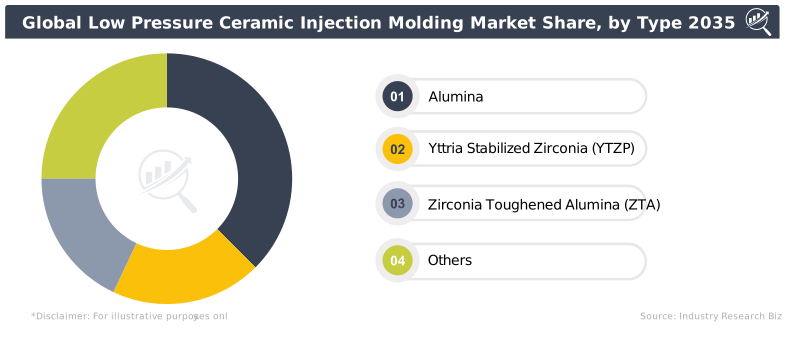
- Market Segmentation: Alumina materials represent 38% of component production, zirconia materials account for 29%, and electrical component applications contribute approximately 26% of total demand.
- Recent Development: During 2024, approximately 47% of manufacturers upgraded debinding equipment, while 39% introduced finer ceramic powders with particle sizes below 0.5 µm.
Low Pressure Ceramic Injection Molding Market Latest Trends
Low pressure ceramic injection molding technologies are witnessing rapid adoption because manufacturers require compact, lightweight, and heatresistant ceramic components for industrial systems. More than 61% of electronic component manufacturers shifted toward microscale ceramic injection molded parts during 2024. Advanced feedstock formulations containing 86% ceramic powder loading are improving mechanical strength and reducing shrinkage variation below 1.5%. Automation integration increased by 53% across molding facilities, especially in Japan and Germany, where robotic debinding systems reduced processing cycle time by 18 hours per production batch.
The semiconductor industry represents a major innovation center for low pressure ceramic injection molding. Semiconductor equipment manufacturers increased usage of ceramic nozzles, insulators, and wafer handling components by 34% during 2024. Yttriastabilized zirconia applications expanded by 28% due to superior fracture toughness exceeding 9 MPa·m1/2. Aerospace manufacturers also increased utilization of zirconia toughened alumina materials in igniters and thermal barrier systems, accounting for 17% of aerospace ceramic molding demand.
How is Technological Advancement Driving the Low Pressure Ceramic Injection Molding Market?
Technological advancement is driving the Low Pressure Ceramic Injection Molding Market through continuous improvements in ceramic feedstock formulations, automated molding systems, robotic debinding, and high-precision sintering technologies. Manufacturers are adopting finer ceramic powders, AI-assisted process control, and automated quality inspection to improve dimensional accuracy, surface finish, and production efficiency. Innovations in micro-molding techniques also enable the production of complex miniature ceramic components with excellent mechanical strength and thermal stability. These developments are expanding the use of low pressure ceramic injection molding across semiconductor manufacturing, electronics, aerospace, medical devices, and other high-performance industrial applications requiring precision and reliability.
Low Pressure Ceramic Injection Molding Market Dynamics
DRIVER
Rising demand for precision ceramic components in semiconductor and electronics industries.
The electronics and semiconductor sectors are major growth contributors for the low pressure ceramic injection molding market. Semiconductor fabrication facilities increased procurement of ceramic insulators, nozzles, and substrate carriers by 37% during 2024. Nearly 68% of semiconductor processing systems require thermalresistant ceramic components capable of operating above 1,000°C. Low pressure ceramic injection molding supports production of thinwall ceramic components below 1 mm thickness, making the technology highly suitable for compact electronics.
RESTRAINT
High processing complexity and expensive feedstock preparation.
Low pressure ceramic injection molding involves multiple production stages including powder mixing, molding, debinding, and sintering, creating operational complexity for manufacturers. Approximately 44% of smallscale ceramic processors reported difficulties maintaining consistent feedstock viscosity. Ceramic powder purity requirements exceeding 99.5% significantly increase raw material procurement costs. Debinding stages consume up to 28 hours for highdensity ceramic parts, limiting production throughput. .
OPPORTUNITY
Expansion of medical and aerospace ceramic applications.
Medical and aerospace industries are creating significant opportunities for low pressure ceramic injection molding manufacturers. More than 48 million minimally invasive surgical procedures were performed globally during 2024, increasing demand for biocompatible ceramic tools and implantable components. Alumina ceramics with purity levels above 99.8% are increasingly used for dental and orthopedic applications because of superior wear resistance and biocompatibility. Aerospace manufacturers increased procurement of ceramic igniters and thermalresistant components by 29% during 2024.
CHALLENGE
Maintaining dimensional accuracy and reducing production defects.
Manufacturers in the low pressure ceramic injection molding market continue facing challenges related to dimensional consistency and cracking during sintering. Nearly 27% of molded ceramic components require secondary finishing due to shrinkage inconsistencies. Uniform powder distribution remains difficult in components with wall thickness below 0.7 mm. More than 32% of producers reported challenges associated with thermal stress fractures during rapid sintering cycles. Mold contamination and binder separation increase rejection rates by approximately 11% in highvolume production lines.
Why is Demand Increasing for the Low Pressure Ceramic Injection Molding Industry?
Demand for the Low Pressure Ceramic Injection Molding (LPCIM) industry is increasing due to the growing need for high-precision, lightweight, and heat-resistant ceramic components across semiconductor, electronics, medical, and aerospace industries. Semiconductor manufacturers have increased demand for ceramic insulators, nozzles, and wafer-handling parts, while medical device companies are adopting biocompatible alumina and zirconia components for implants and surgical instruments. The technology's ability to produce complex shapes with high dimensional accuracy, lower tooling stress, and reduced production costs further supports its adoption. In addition, rising automation in molding, debinding, and sintering processes is improving manufacturing efficiency and product quality, accelerating market growth.
Segmentation Analysis
The low pressure ceramic injection molding market is segmented by material type and application. Alumina dominates the material segment with approximately 38% market participation because of high hardness, thermal insulation, and corrosion resistance. Yttriastabilized zirconia contributes 29% due to fracture toughness and medical suitability. Zirconia toughened alumina accounts for 18% because of wear resistance in aerospace systems. By application, electrical components hold nearly 26% market share, while semiconductor insulators contribute 21%. Medical instrumentation applications represent 19% due to increasing demand for biocompatible ceramic tools. Aerospace igniters account for 14% of molded ceramic component demand, supported by increasing aircraft production and thermal management requirements.
Get Comprehensive Insights on the Market Segmentation in this Report
Download FREE Sample
Get Comprehensive Insights on the Market Segmentation in this Report
Download FREE Sample By Type
Alumina
Alumina represents approximately 38% of the low pressure ceramic injection molding market because of its high dielectric strength, corrosion resistance, and hardness above 1,500 HV. More than 62% of electrical insulation components manufactured through ceramic injection molding use alumina feedstock with purity levels exceeding 99%. Semiconductor applications account for nearly 27% of alumina component demand because alumina withstands operating temperatures above 1,600°C. Medical instrumentation manufacturers increased alumina ceramic utilization by 24% during 2024 for surgical blades and dental implants.
YttriaStabilized Zirconia (YTZP)
Yttriastabilized zirconia accounts for nearly 29% of global low pressure ceramic injection molding demand due to fracture toughness exceeding 9 MPa·m1/2 and flexural strength above 1,000 MPa. More than 44% of molded zirconia components are used in medical applications including dental crowns, orthopedic implants, and minimally invasive surgical tools. Semiconductor equipment manufacturers increased usage of YTZP ceramic nozzles by 31% because of thermal shock resistance and low contamination characteristics.
By Application
Electrical Components
Electrical components account for approximately 26% of the low pressure ceramic injection molding market because ceramic materials provide high dielectric strength and insulation resistance. More than 71% of molded electrical ceramic components use alumina feedstock due to superior electrical insulation performance. Low pressure molding technologies support production of miniature connectors, insulating rings, and circuit protection components with tolerances below 0.2 mm.
Semiconductor Insulators
Semiconductor insulators represent approximately 21% of total market demand due to increasing fabrication plant investments worldwide. Semiconductor processing equipment requires ceramic insulators capable of maintaining stability above 1,400°C while preventing electrical contamination. More than 63% of semiconductor ceramic components are manufactured using zirconia and alumina feedstock. North America and AsiaPacific collectively account for 73% of semiconductor ceramic insulator demand because of ongoing chip fabrication expansion projects.
Which Segment is Growing Faster?
The Alumina segment is growing faster by material type, accounting for approximately 38% of the market due to its excellent hardness, thermal stability, corrosion resistance, and superior electrical insulation properties. Its extensive use in semiconductor equipment, electrical components, and medical devices continues to drive demand. By application, Electrical Components lead with around 26% of the market, supported by rising production of miniature connectors, insulating rings, and circuit protection devices. Expanding investments in semiconductor fabrication, consumer electronics, and advanced electrical systems are further accelerating growth in these segments.
Low Pressure Ceramic Injection Molding Market Regional Outlook
Regional demand for low pressure ceramic injection molding technologies is strongly influenced by electronics production, semiconductor manufacturing, aerospace expansion, and healthcare infrastructure development. AsiaPacific leads the market with nearly 46% of global manufacturing activity due to strong electronics and industrial production. North America contributes approximately 24% because of aerospace and semiconductor investments. Europe accounts for around 22% driven by medical technology and automotive manufacturing. Middle East & Africa represents nearly 8% of demand, supported by industrial diversification and energy infrastructure projects.
Get Comprehensive Insights into the Market’s Size and Growth Trends
Download FREE Sample North America
North America accounts for approximately 24% of the global low pressure ceramic injection molding market because of strong aerospace, medical, and semiconductor manufacturing industries. The United States contributes nearly 82% of regional demand due to increasing investments in semiconductor fabrication plants and aerospace engine manufacturing. More than 18 semiconductor fabrication projects were announced across the region during 2024, significantly increasing procurement of ceramic insulators and wafer handling systems.
Europe
Europe represents approximately 22% of the low pressure ceramic injection molding market due to strong medical technology, automotive, and industrial equipment manufacturing. Germany contributes nearly 31% of European demand because of advanced ceramic engineering capabilities and precision manufacturing infrastructure. France, Italy, and the United Kingdom collectively account for approximately 38% of regional ceramic molding activity.
AsiaPacific
AsiaPacific dominates the low pressure ceramic injection molding market with approximately 46% global share due to extensive electronics manufacturing and semiconductor production activity. China contributes nearly 41% of regional demand because of largescale consumer electronics, industrial machinery, and semiconductor manufacturing operations. Japan accounts for approximately 22% of regional activity, supported by advanced ceramic engineering and precision molding technologies.
Middle East & Africa
Middle East & Africa accounts for approximately 8% of the global low pressure ceramic injection molding market. The region is witnessing increasing adoption of advanced ceramic components in industrial processing, energy systems, and medical equipment manufacturing. Gulf Cooperation Council countries contribute nearly 57% of regional demand because of industrial diversification projects and investments in manufacturing infrastructure.
Which Region Dominates the Low Pressure Ceramic Injection Molding Industry?
Asia-Pacific dominates the Low Pressure Ceramic Injection Molding Industry due to its strong electronics manufacturing ecosystem, expanding semiconductor fabrication capacity, and advanced ceramic engineering capabilities. China, Japan, South Korea, and Taiwan are major production hubs for precision ceramic components used in electronics, aerospace, medical devices, and industrial equipment. Continuous investments in automation, precision manufacturing, and semiconductor production, along with the presence of leading ceramic material suppliers and component manufacturers, continue to strengthen Asia-Pacific's position as the largest and fastest-growing regional market.
List of Top Low Pressure Ceramic Injection Molding Market Companies
- Ceramco
- STC Material Solutions
- Xiamen Fine Ceramics Technology
List of Top tow Companies Market Share
- Nishimura Advanced Ceramics holds approximately 18% market share due to strong production capabilities in precision alumina and zirconia ceramic components used in electronics and semiconductor applications.
- Fraunhofer IKTS accounts for nearly 14% market share supported by advanced ceramic research, industrial partnerships, and highperformance molding technologies for aerospace and biomedical sectors.
Investment Analysis and Opportunities
Investment activity in the low pressure ceramic injection molding market increased significantly during 2024 and 2025 due to expansion in semiconductor, aerospace, and medical manufacturing industries. More than 37 new ceramic processing facilities were announced globally during this period. AsiaPacific attracted approximately 49% of total industrial equipment investments related to ceramic molding automation and sintering technologies.
North America and Europe also witnessed strong investment activity in medicalgrade ceramic production. More than 26 biomedical ceramic development projects were initiated across Germany, the United States, and Japan during 2024. Automated molding and robotic debinding systems reduced labor dependency by nearly 21%, encouraging additional factory modernization investments. Advanced ceramic feedstock development initiatives increased by 24%, particularly for zirconia and hybrid composite materials.
New Product Development
New product development in the low pressure ceramic injection molding market is focused on microscale ceramic components, advanced feedstock formulations, and automated production technologies. More than 43% of manufacturers introduced finer ceramic powders below 0.5 µm particle size during 2024 to improve surface finish and reduce porosity. Highpurity alumina feedstock exceeding 99.9% purity gained traction in semiconductor and electrical insulation applications.
Medical device manufacturers introduced zirconiabased surgical instruments with fracture resistance improvements of 27% compared with conventional ceramic systems. Aerospace companies developed lightweight ceramic igniters capable of operating above 1,350°C while reducing overall component weight by nearly 18%. Automated debinding and AIassisted sintering systems improved dimensional consistency by 14% across new production lines.
Five Recent Developments (20232025)
- In 2025, Nishimura Advanced Ceramics expanded precision ceramic molding capacity by 22% through installation of automated debinding systems for semiconductor insulation components.
- During 2024, Fraunhofer IKTS introduced advanced zirconia feedstock formulations with particle sizes below 0.4 µm, improving density performance by 16%.
- In 2023, STC Material Solutions upgraded thermal sintering furnaces capable of operating above 1,700°C, reducing processing defects by approximately 12%.
- During 2025, Xiamen Fine Ceramics Technology increased production of medical zirconia components by 28% to support rising dental implant demand across AsiaPacific.
- In 2024, Ceramco developed microscale alumina molding technology for semiconductor applications, enabling production of ceramic parts below 1 mm thickness with dimensional variation under 1%.
Report Coverage of Low Pressure Ceramic Injection Molding Market
The report on the low pressure ceramic injection molding market market provides detailed analysis of material types, applications, regional trends, industrial technologies, and competitive developments across global manufacturing sectors. The study evaluates alumina, yttriastabilized zirconia, zirconia toughened alumina, and specialty ceramic materials used in precision molding applications. Application coverage includes electrical components, semiconductor insulators, medical instrumentation, aerospace igniters, agricultural wear components, and industrial systems.
The report examines manufacturing technologies including feedstock preparation, low pressure injection systems, thermal debinding, and hightemperature sintering operations. More than 20 countries were analyzed to assess regional production capabilities, industrial investments, and ceramic component demand patterns. AsiaPacific accounts for approximately 46% of assessed production activity, while North America and Europe collectively contribute nearly 46% of industrial demand.
Low Pressure Ceramic Injection Molding Market Report Coverage
| REPORT COVERAGE | DETAILS | |
|---|---|---|
|
Market Size Value In |
USD 269.78 Million in 2026 |
|
|
Market Size Value By |
USD 545.51 Million by 2035 |
|
|
Growth Rate |
CAGR of 8.14% from 2026-2035 |
|
|
Forecast Period |
2026 - 2035 |
|
|
Base Year |
2025 |
|
|
Historical Data Available |
Yes |
|
|
Regional Scope |
Global |
|
|
Segments Covered |
By Type :
By Application :
|
|
|
To Understand the Detailed Market Report Scope & Segmentation
Download FREE Sample
|
||
Frequently Asked Questions
The global Low Pressure Ceramic Injection Molding Market is expected to reach USD 545.51 Million by 2035.
The Low Pressure Ceramic Injection Molding Market is expected to exhibit a CAGR of 8.14% by 2035.
Nishimura Advanced Ceramics, Ceramco, Fraunhofer IKTS, STC Material Solutions, Xiamen Fine Ceramics Technology
In 2025, the Low Pressure Ceramic Injection Molding Market value stood at USD 249.47 Million.

Related Reports

Our Clients






























.svg)
