

Engine-Driven Welders Market Size, Share, Growth, and Industry Analysis, By Type (Gasoline engine, Diesel engine, LPG fueled engine), By Application (Residential, Commercial, Industrial), Regional Insights and Forecast to 2035
 Buy Now


Engine-Driven Welders Market Overview
The global Engine-Driven Welders Market is predicted to progress from USD 601.79 Million in 2026 to USD 967.46 Million by 2035, registering a CAGR of 5.42% through 2026-2035.
The Engine-Driven Welders Market is expanding as construction contractors, pipeline operators, mining companies, maintenance teams, utilities, fabrication businesses, and remote industrial projects require welding capability independent of grid electricity. Diesel engine models account for approximately 60% of supplied product demand because they combine high duty cycles, fuel economy, durability, generator capability, and suitability for continuous outdoor operation. Engine-driven units increasingly combine welding and auxiliary electrical generation within one mobile platform, allowing crews to power grinders, lighting, plasma cutters, pumps, and other tools at isolated jobsites. Current professional systems commonly provide welding outputs between 200 A and 500 A, while advanced units support multiple processes including stick, TIG, MIG, flux-cored welding, and carbon-arc gouging.
The USA Engine-Driven Welders Market remains strongly supported by infrastructure maintenance, construction, energy projects, mining, agriculture, pipeline servicing, utility repair, and mobile fabrication. North America accounts for approximately 38% of global demand, with the United States representing the majority of regional equipment deployment. Engine-driven welders are particularly important across large construction sites and remote service locations because one machine can deliver welding current while also producing auxiliary electrical power. Current gasoline-powered professional units can provide peak generator output near 12,000 watts, allowing field crews to operate power tools and supporting equipment without a separate generator. U.S. buyers increasingly prioritize automatic engine-speed control, reduced fuel use, quieter operation, compact dimensions, electronic fuel injection, battery charging, and remote welding controls. Equipment rental fleets also remain important because contractors can obtain high-output welding systems for project-specific requirements without maintaining large permanent equipment inventories.
Get Comprehensive Insights into the Market’s Size and Growth Trends
 Download FREE Sample
 Key Findings
- Market Driver: Infrastructure, construction, and remote industrial work remain the strongest demand drivers, with approximately 46% of field-welding requirements linked to applications where reliable grid electricity is unavailable or operationally impractical.
- Major Market Restraint: High-power systems face comparatively limited adoption, with approximately 15% of demand associated with units above 500 A because of higher equipment cost, fuel consumption, weight, and specialized operating requirements.
- Emerging Trends: Compact and lower-output machines are gaining importance, with approximately 45% of market demand concentrated around systems below 300 A for maintenance, construction, repair, and mobile fabrication.
- Regional Leadership: North America leads the Engine-Driven Welders Market with approximately 38% share, supported by extensive construction, pipeline, mining, utility, rental, agricultural, and remote maintenance activity.
- Competitive Landscape: Lincoln Electric maintains the strongest position among supplied companies with approximately 24% competitive presence through broad engine-driven platforms, professional welding technology, distribution coverage, and industrial customer relationships.
- Market Segmentation: Diesel engine leads supplied product demand with approximately 60% share, while Industrial remains the largest application among the 3 supplied end-use categories because of demanding duty cycles and remote operating requirements.
- Recent Development: New professional gasoline engine-driven welders are extending auxiliary capability, with selected current platforms delivering up to 12,000 watts of peak generator power alongside multi-process welding performance.
Engine-Driven Welders Market Latest Trends
Compact, fuel-efficient, and lower-output engine-driven welders are becoming increasingly important, with approximately 45% of market demand concentrated around machines below 300 A. These systems are well suited to construction, repair, maintenance, mobile fabrication, agricultural servicing, and contractor applications where portability and operating economy matter more than extreme output. Current product development emphasizes smaller footprints, reduced machine weight, improved arc quality, simplified control interfaces, and automatic engine-speed adjustment. Modern gasoline units commonly provide outputs between 230 A and 330 A while still supporting auxiliary generator operation. Manufacturers are also improving noise control so equipment can operate more comfortably around populated construction sites and maintenance environments. Single-knob interfaces and digital displays are simplifying parameter setup, while electronic engine management adjusts operating speed according to welding load. These features reduce unnecessary fuel consumption and engine wear during intermittent field work.
Multi-function operation is another major trend as engine-driven welders increasingly serve as mobile power centers rather than welding-only machines. Approximately 35% of professional purchasing decisions now emphasize auxiliary power, battery charging, remote control, or multiple welding-process capability in addition to welding output. Advanced systems can support stick, TIG, MIG, flux-cored welding, and gouging from one platform while delivering several kilowatts of electrical power for field tools. Automatic engine-speed control increasingly varies engine operation between idle and full welding speed depending on electrical load, helping reduce noise and fuel usage. Remote welding controls also allow operators to adjust output closer to the workpiece rather than repeatedly returning to the machine. These capabilities are particularly valuable in structural construction, pipeline repair, mining, and heavy-equipment maintenance where work may occur tens of meters from the power source.
Engine-Driven Welders Market Dynamics
Driver
"Remote infrastructure and maintenance work strengthens demand for independent welding power."
Infrastructure development, construction, and off-grid industrial maintenance remain the strongest market drivers, with approximately 46% of field-welding requirements linked to situations where dependable grid electricity is unavailable or difficult to access. Engine-driven welders provide both welding output and auxiliary generator power, making them valuable on bridges, pipelines, mines, road projects, farms, construction sites, utility corridors, and emergency-repair locations. A single machine can support welding while powering grinders, lights, drills, and other field equipment, reducing the number of separate generators and electrical connections required at remote jobsites.
Mobile equipment repair creates additional demand because a field crew may work more than 20 kilometers from permanent workshop infrastructure during pipeline, agricultural, mining, or utility operations. Engine-driven welders allow technicians to repair structural steel, machinery, buckets, frames, pipework, and other equipment directly at the breakdown location. Reducing the need to transport heavy machinery back to workshops can materially shorten repair time. Rental companies also support market expansion by providing contractors access to welding equipment during temporary projects, seasonal demand, or emergency maintenance without requiring permanent ownership.
Restraint
"High-power equipment carries greater capital, fuel, and operating requirements."
High-power engine-driven welders remain comparatively limited in adoption, with approximately 15% of demand associated with systems above 500 A because these machines require larger engines, stronger alternators, heavier frames, greater fuel capacity, and more specialized transportation. Many contractors can complete routine structural, maintenance, and repair work with machines in the 200 A to 400 A range, reducing the need to purchase significantly larger equipment. High-output units also consume more fuel during sustained operation and may require trailers or dedicated lifting equipment for transportation. These factors limit demand to heavy fabrication, large-diameter pipe, industrial maintenance, mining, and other applications where elevated amperage provides clear operational value.
Engine maintenance creates another restraint because combustion-powered welders include more service-intensive components than grid-connected inverter machines. Professional platforms may require oil changes after several hundred operating hours, alongside periodic filter, spark plug, battery, and cooling-system maintenance. Equipment owners must also manage fuel storage, exhaust, noise, and engine servicing. Where dependable electrical power is already available, workshops may therefore favor conventional electric welders because they eliminate engine maintenance and local fuel consumption. Engine-driven equipment retains its advantage primarily where mobility and power independence outweigh these operating considerations.
Opportunity
"Rental fleets and expanding infrastructure create wider access to mobile welding systems."
Rental-fleet expansion provides a significant market opportunity, with approximately 30% of short-duration construction and maintenance projects increasingly relying on rented or leased mobile welding equipment instead of permanent ownership. Contractors often require engine-driven welders only during specific project stages, making rental attractive for pipeline repair, structural steel erection, shutdown maintenance, mining operations, and emergency response. Fleet operators prefer durable equipment with simplified controls, strong fuel economy, telematics, standardized service components, and broad process capability because one machine can serve several customer types.
Emerging infrastructure programs provide additional opportunity because individual road, rail, pipeline, utility, and industrial projects can require dozens of welding stations operating away from permanent electrical distribution. Portable machines capable of supplying welding power and generator output reduce dependence on temporary electrical infrastructure. Compact diesel and gasoline units are particularly attractive where crews move frequently between work fronts. Suppliers that combine low fuel consumption, remote control, multi-process welding, and simplified transport can capture growing demand across developing industrial regions and reconstruction projects.
Challenge
"Emissions and noise requirements increase pressure on combustion-powered welding platforms."
Compliance with engine emissions and workplace noise requirements remains a major challenge, with approximately 33% of new product engineering activity directed toward cleaner combustion, lower operating sound, improved fuel management, and reduced unnecessary engine speed. Diesel and gasoline machines operate close to workers for extended periods, making exhaust quality and acoustic performance increasingly important on construction sites, in urban projects, and around enclosed industrial facilities. Manufacturers are responding with electronic fuel injection, advanced engine controls, automatic idle systems, improved mufflers, and cleaner certified engines. These changes can increase engineering cost but are necessary to maintain competitiveness in regulated markets.
Battery-based and grid-connected inverter welding also creates competitive pressure because modern electric machines can weigh less than 30 kilograms and operate without local exhaust emissions. Engine-driven welders therefore need to deliver clear value through auxiliary generation, long-duration operation, field portability, and independence from electrical infrastructure. Hybridized jobsite power and battery-assisted tools may further reduce generator demand for light-duty tasks. Manufacturers must continue improving engine efficiency and multi-function capability to preserve the advantages of engine-driven platforms in mobile industrial applications.
Engine-Driven Welders Market Segmentation
Get Comprehensive Insights on the Market Segmentation in this Report
Download FREE Sample
Get Comprehensive Insights on the Market Segmentation in this Report
Download FREE Sample By Type
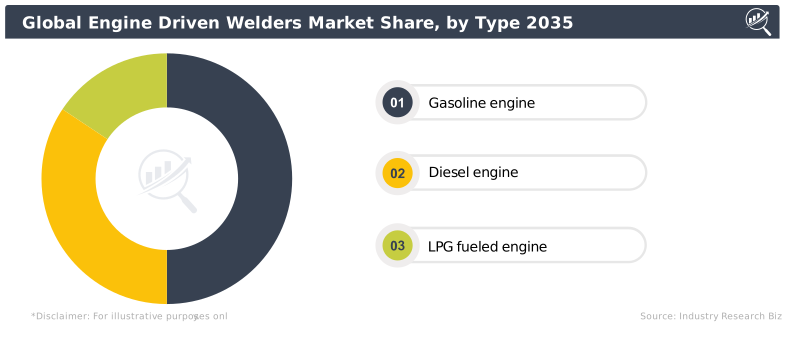
Gasoline engine: Gasoline engine products account for approximately 30% of supplied product demand and are widely used in construction, maintenance, agricultural repair, mobile fabrication, and contractor applications. Gasoline engines are generally lighter and easier to package than comparable industrial diesel systems, supporting compact machines designed for intermittent or medium-duty field work. Professional models commonly provide welding outputs above 200 A while also delivering substantial auxiliary generator capacity.
Modern gasoline platforms increasingly use engines in the 20 hp to 25 hp class, providing enough power for multi-process welding while maintaining manageable machine dimensions. Electronic fuel injection, automatic engine-speed management, quieter exhaust systems, and improved arc control are increasing their attractiveness to mobile contractors. Their main advantages remain portability, broad fuel availability, lower initial equipment cost, and strong performance across general fabrication and construction applications.
Diesel engine: Diesel engine leads the Engine-Driven Welders Market with approximately 60% share. Diesel units are favored across pipeline, mining, heavy construction, industrial maintenance, utilities, and remote infrastructure because they offer robust duty capability, strong fuel efficiency, extended engine life, and compatibility with established heavy-equipment fuel supply systems.
Industrial diesel welders can deliver more than 400 A of welding output while supporting auxiliary generation and extended operation at remote locations. Their heavier construction provides durability for demanding jobsites, while large fuel tanks reduce refueling frequency during long shifts. Diesel platforms remain particularly important where equipment operates daily under high-load conditions and where service infrastructure already supports diesel machinery.
LPG fueled engine: LPG fueled engine systems represent approximately 10% of supplied product demand and provide an alternative where customers prioritize cleaner local combustion, controlled fuel storage, or reduced dependence on gasoline and diesel. LPG configurations are relevant in selected industrial, commercial, and enclosed or emissions-sensitive operating environments where gaseous fuel is readily available.
LPG engines can support professional welding outputs above 250 A while avoiding some fuel-handling characteristics associated with liquid gasoline. Their adoption remains comparatively limited because cylinder availability, storage logistics, and refueling infrastructure vary by location. However, selected rental, maintenance, and industrial users value LPG where established site fuel systems make operation practical.
By Application
Residential: Residential applications account for approximately 18% of market demand and include property repair, agricultural workshops, small fabrication tasks, emergency power support, and home-based welding activity. Gasoline engine models are commonly favored because they provide portable welding and generator capability without requiring three-phase grid power or permanent workshop electrical infrastructure.
Residential and small-property users generally require outputs below 250 A for gates, trailers, equipment repairs, structural maintenance, and general fabrication. Machines that combine welding capability with several kilowatts of auxiliary generator power offer additional value during power outages or work in remote property areas. Ease of starting, compact dimensions, and straightforward controls remain important purchasing factors.
Commercial: Commercial applications represent approximately 30% of market demand and include construction contractors, equipment rental businesses, mobile repair services, fabrication contractors, agricultural service organizations, and utility subcontractors. These users require equipment capable of moving between multiple jobsites while supporting different welding processes and electrical tools.
A commercial contractor may operate a machine for more than 1,000 hours during its service life, making fuel economy, maintenance access, durability, and parts availability important. Rental fleets also favor standardized engine-driven platforms that technicians can service efficiently across multiple units. Remote controls and automatic engine-speed management improve productivity on construction and repair projects.
Industrial: Industrial applications lead supplied end-use demand with approximately 52% share across mining, pipelines, heavy equipment, energy infrastructure, industrial maintenance, structural fabrication, and large construction operations. These environments favor diesel engine platforms because machines frequently operate for extended shifts while powering both welding processes and auxiliary equipment.
Heavy industrial systems can support welding outputs above 500 A for demanding gouging, pipe, structural, and repair work. Industrial buyers also prioritize lifting points, trailer compatibility, heavy-duty enclosures, large fuel capacity, and serviceability. Mining and pipeline operations particularly depend on engine-driven welding where fixed electrical infrastructure may be unavailable across large operating areas.
Engine-Driven Welders Market Regional Outlook
Get Comprehensive Insights into the Market’s Size and Growth Trends
Download FREE Sample North America
North America leads the Engine-Driven Welders Market with approximately 38% share. Regional demand is supported by construction, pipeline maintenance, mining, utility repair, agriculture, equipment rental, heavy fabrication, and remote infrastructure activity. The United States remains the principal market because contractors frequently need self-contained welding systems for projects operating beyond permanent electrical infrastructure. Engine-driven units are widely deployed across bridge work, structural steel installation, field repair, oil and gas maintenance, and emergency-response operations.
North American rental fleets often operate hundreds of mobile welding units across multiple branches, making durability, simplified controls, maintenance access, and parts availability important procurement factors. Contractors increasingly favor machines that can combine stick, TIG, MIG, and flux-cored welding with auxiliary generator output. Automatic engine-speed management and remote controls are also gaining importance because they reduce unnecessary idling and allow operators to adjust settings closer to the work area.
Europe
Europe accounts for approximately 22% of global market demand, supported by infrastructure maintenance, fabrication, rail projects, construction, ship repair, utilities, and industrial servicing. Diesel engine-driven welders remain particularly relevant for contractors operating at temporary worksites, ports, energy infrastructure, and remote repair locations where grid electricity is unavailable or unreliable. European buyers increasingly prioritize compact equipment, lower acoustic output, cleaner combustion, and fuel-efficient engine operation to meet stricter jobsite requirements.
Many European infrastructure projects require mobile welding equipment to operate for more than 8 hours during a working shift, increasing demand for reliable fuel systems, long service intervals, and durable weather-resistant enclosures. Contractors also value multi-process capability because one machine can support several repair and fabrication tasks. Growing use of automated engine-speed control and improved exhaust systems is helping manufacturers adapt combustion-powered platforms to tighter environmental and workplace standards.
Asia-Pacific
Asia-Pacific represents approximately 28% of the Engine-Driven Welders Market and benefits from extensive infrastructure construction, mining, shipbuilding, manufacturing, oil and gas projects, rail development, and power-sector investment. China, India, Japan, South Korea, Australia, and Southeast Asia create strong demand for mobile welding equipment across both industrial and commercial applications. Diesel systems remain important because large infrastructure sites and mining operations often require long-duration welding independent of permanent electrical supply.
Large construction and industrial projects across the region can involve more than 20 mobile welding stations operating simultaneously across separate work fronts. This creates demand for standardized equipment that can be moved easily, serviced quickly, and supported by common spare parts. Regional manufacturers are also expanding value-oriented engine-driven platforms for contractors seeking lower acquisition costs while maintaining essential welding and generator functions.
Middle East and Africa
Middle East and Africa account for approximately 7% of market demand, supported by oil and gas infrastructure, pipeline construction, mining, utilities, industrial maintenance, and large civil-engineering projects. Engine-driven welders are particularly valuable in remote desert, mining, and pipeline environments where permanent electricity may be unavailable across extensive project areas. Diesel units are commonly preferred because they align with fuel infrastructure already used by heavy equipment fleets.
Pipeline and industrial maintenance projects may require mobile welding equipment to operate more than 10 kilometers from permanent workshop facilities. Contractors therefore prioritize machines with large fuel tanks, trailer compatibility, lifting points, and reliable multi-process welding capability. Serviceability and parts availability remain critical purchasing considerations because equipment downtime can interrupt larger construction or maintenance schedules.
Rest of the World
Rest of the World represents approximately 5% of global demand. Demand is distributed across Latin America and smaller industrial economies where mining, agriculture, construction, energy infrastructure, and equipment repair create recurring requirements for portable welding and generator systems. Contractors increasingly select compact diesel and gasoline units that can serve both fabrication and emergency power functions.
Regional users frequently prioritize machines capable of supporting more than 2 welding processes because equipment versatility reduces the number of separate power sources required at remote worksites. Infrastructure expansion and rehabilitation of aging industrial assets continue supporting gradual market development. Local dealer support and access to engine service components remain important factors influencing purchasing decisions.
List of Top Engine-Driven Welders Market Companies
- Lincoln Electric
- Miller
- ESAB
- Denyo
- Shindaiwa
- MOSA
- Telwin
- Genset
- Inmesol
- Green Power
- KOVO
- Xionggu
- Genelite
Top Two Companies With Highest Market Share
- Lincoln Electric: The company maintains approximately 24% competitive presence among the supplied leading participants through broad engine-driven welding platforms, established industrial relationships, advanced welding technology, and extensive distribution and service coverage.
- Miller: The company represents approximately 21% competitive presence among major supplied participants, supported by strong professional welding equipment, contractor-focused products, generator capability, remote controls, and established adoption across construction, pipeline, fabrication, and industrial maintenance applications.
Investment Analysis and Opportunities
Investment activity is increasingly focused on fuel-efficient engines, connected fleet management, rental equipment, and multi-process platforms, with approximately 30% of short-duration construction and maintenance projects increasingly favoring rented or leased welding equipment. Rental companies are investing in standardized fleets that combine welding output with generator capability and simplified operator controls. Manufacturers that provide telematics, maintenance scheduling, remote diagnostics, and common service parts can strengthen relationships with fleet operators and improve equipment utilization across geographically distributed branches.
Infrastructure development and remote industrial projects create additional opportunity, with approximately 27% of current investment interest associated with equipment designed for construction, pipelines, mining, utilities, and heavy repair. Suppliers are expanding trailer-ready platforms, larger fuel tanks, automatic idle management, and remote welding controls to improve productivity across long-duration field assignments. Demand is especially attractive in regions where temporary electrical infrastructure remains costly or impractical across large project areas.
New Product Development
New gasoline engine-driven platforms are increasingly combining higher welding performance with stronger auxiliary power capability, with selected professional systems delivering up to 12,000 watts of peak generator output. This allows contractors to operate grinders, lighting, plasma equipment, pumps, and other tools from the same machine used for welding. Product development is also emphasizing electronic fuel injection, automatic engine-speed control, compact packaging, and improved acoustic performance.
Diesel product development is increasingly centered on reduced fuel consumption, cleaner exhaust, and higher duty capability, with approximately 33% of engineering activity focused on emissions, noise, and engine-efficiency improvements. Manufacturers are refining cooling, alternator efficiency, control electronics, and enclosure design to maintain strong field performance while reducing unnecessary engine load. Remote output adjustment and digital parameter displays are also becoming more common in premium professional equipment.
Five Recent Developments
- January 2026 – Compact Gasoline Platforms Gain Features: Manufacturers expanded smaller engine-driven welder platforms with improved auxiliary power, simplified control interfaces, automatic engine-speed management, and stronger multi-process capability for contractors and mobile repair users.
- February 2026 – Diesel Efficiency Upgrades Expand: New diesel-powered systems introduced improved fuel-management, cooling, and engine-control features intended to support longer operating cycles across construction, mining, pipeline, and industrial maintenance projects.
- March 2026 – Rental Fleet Connectivity Improves; Suppliers expanded telematics and maintenance-monitoring options that help rental companies track machine utilization, operating hours, service requirements, and equipment availability across distributed fleets.
- May 2026 – Remote Welding Controls Advance: Professional engine-driven platforms added improved remote output adjustment and digital control options, allowing welders to modify parameters closer to the work area without returning repeatedly to the machine.
- July 2026 – Multi-Process Product Portfolios Broaden: Manufacturers introduced additional field systems capable of supporting several welding processes while simultaneously providing auxiliary generator power for tools, lighting, and supporting equipment.
Report Coverage of Engine-Driven Welders Market
This Engine-Driven Welders Market report evaluates Gasoline engine, Diesel engine, and LPG fueled engine products across Residential, Commercial, and Industrial applications. The analysis covers field welding, auxiliary power generation, fuel efficiency, remote construction, pipeline maintenance, mining, equipment repair, rental demand, multi-process capability, engine management, noise reduction, emissions control, and evolving mobility requirements across professional and household environments.
Competitive coverage includes Lincoln Electric, Miller, ESAB, Denyo, Shindaiwa, MOSA, Telwin, Genset, Inmesol, Green Power, KOVO, Xionggu, and Genelite. The report examines how these companies are responding to contractor demand for portable welding power, stronger generator functionality, lower fuel use, simplified control systems, remote operation, rental-fleet requirements, and durable equipment suited to infrastructure, industrial, and off-grid applications.
Engine-Driven Welders Market Report Coverage
| REPORT COVERAGE | DETAILS | |
|---|---|---|
|
Market Size Value In |
USD 601.79 Million in 2026 |
|
|
Market Size Value By |
USD 967.46 Million by 2035 |
|
|
Growth Rate |
CAGR of 5.42% from 2026-2035 |
|
|
Forecast Period |
2026 - 2035 |
|
|
Base Year |
2025 |
|
|
Historical Data Available |
Yes |
|
|
Regional Scope |
Global |
|
|
Segments Covered |
By Type :
By Application :
|
|
|
To Understand the Detailed Market Report Scope & Segmentation
Download FREE Sample
|
||
Frequently Asked Questions
The global Engine-Driven Welders Market is expected to reach USD 967.46 Million by 2035.
The Engine-Driven Welders Market is expected to exhibit a CAGR of 5.42% by 2035.
Lincoln Electric, Miller, ESAB, Denyo, Shindaiwa, MOSA, Telwin, Genset, Inmesol, Green Power, KOVO, Xionggu, Genelite
In 2026, the Engine-Driven Welders Market value will reach at USD 601.79 Million.

Related Reports

Our Clients






























.svg)
